Saint Olga of Kiev, my 34th great grandmother

Saint Olga of Kiev, my 34th great grandmother
SAINT OLGA OF KIEV, MY 34TH GREAT GRANDMOTHER
Showing posts with label Vedanta. Show all posts

Thursday, August 11, 2022

THE FINAL POST - FOR THE TIME BEING


View from the hermitage
by
Silver S. Parnell
(c) copyright 2020
All rights reserved.

As much as I love researching and writing this blog diary of my life in the modern urban hermitage, this will be the last post for some time.

At some point I intend to re-work the information about the mostly little-known saints, paint or sketch some representatives of them, and publish a small book. 

I am not finished researching the lesser-known saints, so it is likely that I will return to writing when I am feeling more fresh.

Almost all my posts have involved many hours of research and creative writing, but it is hard to find the time for this, since I am physically disabled and it is taking me longer and longer to accomplish basic tasks of survival. This is the primary issue that challenges me at the moment.

On the other hand, because I am able to do little else than sit in this recliner, the time spent while sitting here may as well be dedicated to working for the glory of God when I am not praying. 

Two years ago, I was approved for a caregiver of 28 hours a week, and I have tried throughout that time to get a caregiver through the approved agencies, but there are none to be had in the present economy. I have written about some of these experiences.

The problem seems to be that no one wants to do this type of work for what Medicaid will pay, unless they are a family member who is already taking care of a relative. This is why, every time I signed up with another agency in hope of finding some help, they also asked me, "don't you have a relative you can bring with you? 

There ARE some caregivers doing this type of work in this town, but apparently, most are demanding CASH payment, then hiding their income to avoid paying taxes. This is short-sighted, because when they themselves become disabled or retire, they will have to live off the money that other folks have put into the system, and will thereby drain it of its resources and hurt the economy and the taxpayers as a result. Even if I had the cash to pay one of these people, I would not want to participate in an illegal scheme. I will say, however, that this trend of refusing to pay people a living wage has got to change in America. It really does. Far fewer people will feel compelled to dodge the taxman with illegal schemes if they don't have to go hungry to stay within the law while working a full time job!

To be honest, it was never my idea to have a blog to begin with. It was suggested by a friend who, aware of the tradition of the laity supporting monastics, thought  it might help support me, but I suspect that she was as uninformed as I was about the practicalities of how this would work.

Also, the interest in connecting with other contemplatives has lessened while there have appeared a new crop of automated "prayer" apps for one's computer and telephone. This mirrors a general trend of people shifting away from contact with other humans, and replacing them with mechanical servants, which is really too bad. I think we will find, in future, that it is detrimental to the human spirit to do this.

I am already finding that hardly anyone will answer a telephone call any more. They flatly refuse to respond to anything but a text, which is difficult for a disabled person, especially those of us who are blind in one eye!

I will keep this blog active, and you will still be able to contact me through the comments, if the need arises, and the DONATE button (underneath my photo, above right) will also work. 

Please pray for me, as I pray for you, and look for my books in future. I will come here and tell everyone about it when we have a publication date.

In the meantime, may we all be blessed!

Silver Rose


Sunday, July 24, 2022

SAINT KINGA OF POLAND, MY COUSIN - July 24, 2022


Saint Kinga of Poland
Depicted holding her monastery
at Stary Sacz
b. 5 March 1224 - d. 24 July 1292
My 7th cousin, 25 times removed


My 7th cousin, 25 times removed, is Saint Cunegunde, also called Zinga, Kioga, or, more popularly, Saint Kinga of Poland. Saint Kinga of Poland, Patroness of Poland and Lithuania, was born 5 March 1224 In Esztergom, Hungary.  She was the princess daughter of King Bela IV of Hungary and was a niece of Saint Elizabeth of Hungary and the great niece of Saint Hedwig.  An illustrious and pious family, her sisters were Saint Margaret of Hungary and Blessed Jolenta of Poland.


The sisters:
Saint Margaret of Hungary, Saint Kinga of Poland, 
and Blessed Jolenta of Poland

Both Kinga and her husband, Boleslaw V "the Chaste" embarked upon a marriage in which both parties were vowed to perpetual chastity.  Boleslaw's family was similarly pious and sincere.  His sister was blessed Salome of Cracow.  When he ascended to the throne as Prince of Cracow, Kinga became his princess.  Kinga soon began to devote herself to the care of the poor and the lepers and was known, both for her deep concern for the people, and her obedience and devotion to Christ and His Church.


Saint Kinga's husband
Boleslaw V "The Chaste"
Duke of Poland
b. 21 June 1226 - d. 7 December 1279


The storyline in which a saintly person vows lifelong chastity is common in Orthodox Church,  Catholicism , as well as other major religious traditions. In the Hindu faith, it is linked with the path of Enlightenment through meditation. Without celibacy, progress on the path toward spiritual enlightenment is considered negligible. Each religion has its own narrative of exactly WHY this is true. I just think it is interesting that the focus on restraint of the sex urge is an important one in all major religious traditions.

Kinga is patron saint of the salt miners, and the salt mine of Wieliczka in Poland has a large chapel dedicated to her that is 101 meters under ground.  It is a remarkably beautiful Cathedral that is able to accommodate about 400 people.


Poor Clare's Monastery
at Stary Sacz


When her husband died in 1279, Kinga sold all her possessions and gave the money to the poor.  Not long after that, she joined the Poor Clares monastery at Sandec (Stary Sacz).  Matters of state, and the prestige of her royal position, held no interest for her.  She was too modest and humble to have any taste for such power. Her heart belonged to Christ alone.  In fact, she would allow no one to call her by her official title of Grand Duchess of Poland.

Hers is a beautiful comment on the reality of the emptiness of fame, wealth, status and prestige. None of it comes close to the experience of the Lord in our hearts. Touched by the grandest force of all, humility would naturally occur, don't you think? It is from her humility that I surmise that she had a profound mystical experience of the Lord at some point.


While her life with the prince had been characterized by charitable works and service, her time in the monastery was spent in silent contemplation.  In 1292, at the age of 68, she passed from this world. In 1690, she was beatified, and in 1999 she was sainted.

Saint Kinga's convent, the Monastery of the Poor Clares, in Stary Sacz, Poland, remains a much-beloved landmark in the oldest section of this historic little town.


Poor Clares Monastery
Stary Sacz

On June 16, 1999, Pope John Paul II visited Stary Sacz, the town of his birth, for the proclamation of the canonization of beloved Saint Kinga.  A papal altar was erected on the common outside of the monastery that Kinga created and in which she had died.


Wooden altar at Stary Sacz
built for Pope John Paul II's visit


When suffering from headache, I recommend very simple rote prayers, such as the Jesus Prayer or the Rosary

Jesus Prayer

Lord, Jesus Christ,
son of God,
have mercy upon me,
a poor sinner.

Saint Kinga would have been familiar with the Jesus Prayer. It is a prayer used very much by Orthodox monastics and often "counted" on rope prayer beads. I have a set of these myself.


My prayer rope
I keep it in a box with my
Chaplet of Divine Mercy


The Jesus Prayer was probably first set out in the Philokalia, that great Orthodox spiritual work, in a discourse on Abba Philimon. What I have written out, above, is the "long" version that can be reduced to the shortest form: "Lord, Jesus Christ, have mercy upon me," but the version in the Philokalia only omits "a poor sinner" from its text.

Here we have another example of how the major religious traditions mirror one another in certain spiritual practices. The Jesus Prayer of the Orthodox faith, counted on knotted rope strands, is reminiscent of the Zen Koan's and the Hindu Mantra, and a little less similar to the Rosary, which is far more complex and involves meditations upon a variety of concepts.

Contrasting the role of Jesus as "son of God" with our own, "a poor sinner," sets us up for a more humble frame of mine. I imagine it is probably always good to keep in mind the difference between ourselves and The Lord.

Care has to be taken not to become attached to these things as a sort of magic talisman, of course. Advanced spiritual aspirants realize this without being told. I DO like to advocate for the beauty of the rosaries, chaplets, prayer ropes and the like, because beauty DOES attract us and, if it can attract us to something good and holy, then beauty serves a divine purpose. This is why I am not one of those people that blabs about how we should live so simply that we do not allow ourselves any beauty at all. That philosophy is the death of art and just causes stress, as far as I am concerned. Some Protestant sects are overly concerned with making things as PLAIN as possible. Certainly, a plain rosary is absolutely fine to use - but must we all have the same? No.


Rosary I made for myself
with my 29th Great Grandmother,
Saint Margaret of Scotland,
in the center piece
(Design is my original and copyrighted!)


A few years ago, I made myself a nice rosary of St. Margaret of Scotland, with her centerpiece and some lovely beads and charms that remind me of my Celtic, English and Scottish heritage. I did something unique with the bead caps to help keep me going in the right direction so that as my vision recedes more and more, I am able to follow the rosary without a problem.

There is nothing wrong with incorporating beauty into one's spiritual accoutrements. Certainly one can achieve the same result with a wood rosary or a silver one, but it's a matter of style, as far as I can see, and we shouldn't judge one another by it. Everyone has their own taste and inclinations.

This coming week, I have another eye doctor appointment. It seems like I was just there yesterday! I am praying that I do not have to have another shot in my eyeball, as I did last time! The doctor keeps lobbying to just give me the shots every month, and he gives me a headache with the pressure. My blood pressure goes up after he gives me one of these shots, and I just don't want to have them unless something is happening in my retina that calls for it. I am not fond of the anaphylactic approach.  Besides which, if I know that I am definitely getting a shot in my eye, I tend to apprehend it and my anxiety level rises. It's just what happens with PTSD. There is no magic bullet to make this stop. It's just one of the symptoms I have to deal with.  Anyway, please pray for me that the necessity for the shots will disappear and that I can stop doing this every month! I do know someone who had three shots and then never had to do it again, so it is not unreasonable to hope that I may do likewise.

Please pray for me as I pray for you, dear friends!

Next month is my birthday, and I have made an Amazon birthday wish list. I am still trying to do something positive with my diet, but food is so very expensive at the moment, it is hard to do! Ordering is easy. Amazon has my address and mails to me direct.

Here is the LINK - CLICK HERE

May we all be blessed!

Silver Rose
Sannyasini Kaliprana

P.S. All of the blog posts I write are independently researched and written by me and all of them are protected by legal copyright, so please just enjoy them here and leave them here where you found them and do not copy any of it to any other place for any purpose.

(c) Copyright 2022, Silver S. Parnell
All rights reserved.

SAINT WANDRILLE, my cousin, July 22, 2022


Saint Wandrille (Wandregisel)
born about 605, died 22 July 668


Saint Wandrille (aka Wandregisel) is related to several of my relatives that figure prominently in his story, though it was hard to find a picture of him. Of course, the 7th century does not have a lot of paintings of minor nobility left for us to look at. The one above is a stained glass window depicting the saint. Also, he is more well known for the Abbey of Fontenelle than his visage. Who knows? Perhaps he resisted getting a painting made of himself, being too religious to allow his face or personality to become the topic. 

If you are interested in the history of the Fontenelle Abby and Saint Wandrille, Wikipedia has some good information HERE


Cloisters and Courtyard
Fontanelle Abbey
Abbey of Saint Wandrille
Saint-Wandrille-Rincon

I had hoped to finish writing this on the 22nd, so everyone could have a chance of reading it on his feast day, itself, but my cousin, Saint Wandrille, proved to be so intertwined with many of my ancestors, that I found I had to spend a great deal more time piecing his story together than I had anticipated. I became fascinated with certain aspects and had to chase the rabbit down several holes - all of which are interconnected in a spiritual rabbit warren of delights!

In addition, as I continue to work on this blog post on the evening of the 23rd of July (and am far from finished) I am rounding the corner on day 3 of the worst headache I've ever had in my whole life. It has been years since I've had such a migraine, and even strong painkillers were of little use. Even after a nap yesterday, a full night of sleep, and rising from bed after noon, and then napping again from 2 until almost 6 p.m., I am still struggling to get a handle on it, though I no longer feel like I am on the verge of death and tempted to write loving farewell messages to everyone.

The stress of having that "caregiver" in my house who was in her own world and not a terribly honest or sincere person, and to be faced with the stress of having to clean up after someone ELSE when I am losing the ability to clean up after myself, has made my stress level skyrocket. I can never do this again. It has been a lesson to me. I will do without a caregiver and, instead, work on simplifying everything in my life.

The advantage of being a hermit is supposed to be the simplicity of the life, but unless one is REALLY isolated, there is the tendency for things to accumulate around oneself.  For instance, the modern cooking conveniences are tempting but, in the end, useless to someone who can no longer actually COOK for herself. Never let anyone convince you that appliances and cookery gadgets take the place of other people doing the actual work. It is a lie. The best thing to do, I have now learned, is to keep very minimal possessions in the kitchen and to eat raw fruits and veg and sandwiches, and perhaps some frozen meals.

Today I had a chat at the mailboxes with one of my elderly neighbors who lives alone after the death of his spouse a year or two ago.  He is not a religious person, but he has also realized the futility of possessions after a certain point in life, due to the very reason I have mentioned. We are too tired to use them!

I have to divest myself of many THINGS that have come to me through the kindness of well-wishers or through my own misguided idea that it would make things simpler somehow.

Also, since I am ACTUALLY alone, and not alone in concert with other people who are cooperating in the work of a place, I have to accommodate my needs in ways that someone living in a monastic institution would not have to do. There may be occasions when I have to eat in a restaurant, for instance.  I am not going to feel bad about it if I have to resort to that. I am doing the best I can.


WEBSITE FOR ABBAYE DE ST. WANDRILLE

When reading about the wanderings of my cousin, Saint Wandrille, and how he so quickly could switch from a courtier to a religious hermit at a location FAR away, and then 4 or 5 years later move again, and then again - the thing that kept being communicated to me is that OF COURSE he was able to go galivanting all over the country: he had so few THINGS to carry with him!

I remember, with fondness, how, when I left the convent and got my own apartment, I sat on cushions in the living room and used folding breakfast trays as my "end tables." I slept on a mattress on the floor. Those were my only furnishings. Now, my creaky old carcass needs all sorts of amenities, just to get to the point where I am able to grab even 4 hours sleep at night, but I experience nostalgia, now and then, for the days when I could make the decision about furniture and it was not made for me by virtue of the condition of this miserable body! I really need to make some changes so that I can make do without a caregiver.

Once, a nun called me "house proud" because I made her put her steaming mug of tea on one of my breakfast trays rather than my landlord's new carpet. I was rather more thinking of the deposit I would lose if there were tea stains on the carpet when I moved out, as I was living entirely on the floor and had no furniture at all. Today, that nun could rightly accuse me of being mired in worldly possessions, that's for sure.

 I mention her now because I dreamt about her last night, as well as some other nuns. It was an odd dream. We were all wearing full-length gerua robes of the variety one wears for formal occasions. I say "formal," because the sleeves were big and wide. It would be impossible to do much with THOSE sleeves! The material was substantial and rustled when we moved.

I was leading us all into another religious institution. It was a very big house. The lighting was low, the mood serene. No furniture at all - but I was leading them into the shrine room where there would be an altar, and I believe I was introducing them to the place. My friend who called me "house proud" in that early apartment of mine was following close behind me, as if she was trying to catch up with me and ask me something. But no one was speaking, and I did not want to talk. All I could hear was the rustling of the fabric of the beautiful pinkish-orange robes. We were bare-footed, so there was no clatter and echo of shoes on the floor.

 It was one of "those" dreams that gave me the impression that I had actually visited with her. When I woke, I wondered if she was alright because it has happened to me many times in my life that when I have a dream that feels like this and it involves someone I know, it is a visitation from a person who has just died, and I do not find out until later that the person has left this mortal plane. Sometimes I get a message from the person that stays with me forever. 

People do not evaporate when they die. There are minds far greater than mine who have lent their personal experiences, intellect, and writing talent to explain it. All I know is that all my saintly ancestors are today as real as they ever were. When we talk to them, they hear us, and they accompany us in our daily trails. They are our holy family. That is all I know, but this is one of the reasons why I research my ancestors and other saints that interest me because they're not dead. The people who lived as hermits, nuns, priests, bishops, kings and queens - who left abbeys and churches, institutions, or long lines of descendants are with us today. The dust of the years may be on the things they left behind, but there is no dust on them!


Blessed Pepin I of Landen (Modern Belgium)
aka Pepin the Elder or Old
Lord of Brabant
Governor of Austrasia
b. about 580 - d. 27 Feb. 640
and his wife
Saint Itta of Metz
b. 592 - d. 8 May 652
My 39th Great Grandparents

Saint Wandrille is something like my first cousin, 42 times removed. He was a relative of Blessed Pepin I, who is my 49th Great Grandfather. I am positing that Saint Wandrille's father, whose name was Walchisus, was possibly a son of Carloman or one of Carloman's siblings. (This is NOT the Carloman of the 8th Century, obviously.) At this point, we just don't have enough information to say concretely how it was, exactly, that Wandrille was the "kinsman" of my great grandfather, Blessed Pepin I, but he was some kind of cousin. That is all we know from the historical record.


Wandrille was educated in the Frankish court in Metz.  He would have been a contemporary of the children of Arnoald and Oda of Metz, all four of whom were sainted (Doda, Itta, Modoald and Severa.) This seems significant to me, as it accounts for the religious seed planted within him so strongly, that later manifested itself. His early companions were all saints!


Saint Itta of Metz
who was married to Blessed Pepin

It's fun to put together the information I've learned in my research about Wandrille with the genealogy research I'd previously done on the court of Metz, as Arnoald of Metz and his wife Oda were my 39th great grandparents! As in other families of such an early era, I found that I was descended from TWO of Arnoald's children: both Saint Doda (Clothilde) and Saint Itta of Metz were my 38th great grandmothers! Doda was married to Saint Arnulf of Metz, and Itta was married to Blessed Pepin I, mentioned above.


Saint Doda of Metz

my 38th Great Grandmother
b. about 584

Wandrille went on to become a courtier who served Dagobert I, son of Clotare II, "The Great." Dagobert was the King of the Franks, Austrasia, Neustria and Burgundy and was my 2nd cousin, 40 times removed. (Again, for those not familiar with my blog, I will explain that the nobility of Europe intermarried so often that I am a cousin to myself 100 times over, it sometimes seems. When you are descended from certain key people, one seems to be be descended from all the royal houses. That's just the way it is. Americans whose families have been in this country since the 1600's and early 1700's are often these types of descendants from royal families.  "The 2nd sons" who did not inherit the titles, thrones and lands of their fathers in Europe, were thrilled to come here and own land in the New World.)

It seems that Wandrille quickly tired of life at court because he retired to become a monk at Montfaucon when he was still in his 20's, in 629. Saint Balderic, my 42nd great granduncle, was his mentor. Evidently, Saint Wandrille had done this hastily, as he'd not gotten approval from Dagobert, who eventually gave the nod. In those days, one had to get the approval of the king for EVERYTHING one did. They did not have the many freedoms to which we as Americans are so accustomed and take for granted as our right. Life at court had its advantages, but in many respects, it was (and probably still largely IS) a golden cage.


Statue of St. Balderic
My 42nd Great Granduncle

Although Saint Wandrille had been married, early on, he and his wife separated, by mutual consent, each of them to retire to a religious life, sometime prior to his becoming a religious and leaving court.  This is a theme that repeats itself throughout the history of our faith. There is something compelling about the monastic life that seems inborn and spontaneous, so that no matter what sort of life one has to live in order to support one's physical being, in the end, it is only God that matters at all, and once the frantic toing and froings of young life, it is natural to focus in on what matters. This is what I have done over the last 20 years, and although some Americans think it "kookie" or bizarre, it is part of a long tradition shared by many religions. We come from God and return to God in some fashion of other, and this process is interpreted variously by the various religions. I am descended from dozens of Celtic and European saints and THIS is in my blood, so it is how I naturally come to feel at home.

After accomplishing one's worldly duties, it almost seems natural to retire and devote oneself to God. This is a theme that Christianity shares with Hinduism, and probably other major religious traditions as well. This touches on a frequent concept in my writings. All the major religions traditions have a great deal in common, from the aims of spiritual life to the methods of arriving at that aim. Each expresses the goal differently, but when we are open to the harmony of all religions, it is quite easy to see. Joseph Campbell did a wonderful series of interviews on this topic, years ago, based upon his books.

The portion of Saint Wandrille's life I'm particularly keen to learn more about is when he went to live as a hermit in "complete solitude" at "Saint-Ursanne in the Jura." It is named for Saint Ursicinus, a seventh-century monk who built at least one monastery (and credited for more, I believe) in that locale and with whom Saint Wandrille must certainly have been acquainted. This is a fascinating tidbit that I hope to chase up later.


Today, Saint-Ursanne is a small town in Swizterland that maintains a distinctly medieval flavor, with many houses still standing from that era, as well as "a hermitage and an 18th century bridge," according to Wikipedia. I am going to guess that the ruins of that hermitage are most likely built on the premises of the hermitage that Wandrille occupied at the time he was there, in the 7th century, but that is something I would have to research further. Saint Ursanne is one of the MANY places I would have loved to have visited, had I not become disabled so early in life. Every summer, this town hosts a festival for a famous international "hill climb" in August. Thank God for the internet, though, eh? I have to "put a pin in it" and return to this research at a later time. With these rather more obscure topics and smaller locales, research is often limited by differences in language. I do not know any German, and I possess only a smattering of French, so this research may have to rely upon the work or assistance of others at a later time.


The bridge at Saint-Ursanne

Wandrille spent no more than 5 years at the hermitage because, by 635, he was at the monastery of Saint Columban (a contemporary of Ursicinus), at Bobbio in Northern Italy. He also planned to travel to Ireland but never got further than the Tarentaise Valley in the Swiss Alps of France.

After this, he was ordained priest and founded Fontenelle Abbey in Normany. His friend Archbishop Audoin of Rouen advocated for it with Erchinoald, who donated the land for the purpose. It was Wandrille's "last stand" and probably his greatest accomplishment, as it became a center of great learning. The ruins of the Abbey are located near the Village of Saint-Wandrille Rancon.

I would have loved to visit this village also. It is primarily focused on farming and forestry and is situated on the banks of the River Seine, 18 miles north-west of Rouen. Saint Wandrille's Abbey's is his primary "claim to fame" and it is very quaint and impressive, but the Abbey that stands today, in ruins, is not from Saint Wandrille's era, though no doubt built on the earliest ruins. The current façade belongs to the 13th and 14th Centuries and is described beautifully in the Wikipedia page for Saint-Wandrille-Rancon, subtitle "Places of Interest."


Village of Saint-Wandrille-Rincon
at Wikipedia

As I finish the written portion of this blog, I am hearing gun fire not far from where I live, on the banks of the Rio Grande River, close to the area of the "South Valley" where there are a lot of little ranchitos that are very old and quaint. Some of them have adobe ovens outside their homes. I believe they are called "hornos."


You can see the familiar shapes and imagine the wonderful baked goods that come out of them. This area is steeped in history but I have not had a chance to know any of these people, since I moved here after I became disabled, and the lifestyle of a hermit is not a social one. The gun fire is concerning, though, because what goes up must come down.

But I still manage to meet people in the parking lot, as there are more than 70 apartments here. Day before yesterday, I helped a lovely woman with her car and some advice about how to discourage the thieves from breaking into it. She got the car started. In gratitude, she came to my apartment the next morning and brought me a lovely package of home-made frozen chile rellenos. These and tamales are traditional foods that communicate culture and love to those to whom they are gifted, and I am particularly grateful for these. I have a friend who gives me home-made pozole at Christmas - another New Mexico custom!

My headache is mostly gone, so I hope when I wake later on it will have disappeared. Please pray for me in that regard. Also, please pray that I am able to simplify my hermit life in this little apartment in a way that will enable me to care for myself and also follow through with my religious practices.

May we all be blessed!

Mother Silver Rose
Sannyasini Kaliprana

P.S. All of the blog posts I write are independently researched and written by me and all of them are protected by legal copyright, so please just enjoy them here and leave them here where you found them and do not copy any of it to any other place for any purpose.

(c) Copyright 2022, Silver S. Parnell
All rights reserved.

Thursday, July 21, 2022

Saint Ealhswith, my 33rd great grandmother, July 20, 2022


Saint Ealhswith
aka Ethelwitha, Etheldwitha,
Ethelwida
 b. abt 850 - d. 5 December 905

Wife of Saint Alfred the Great
Patron saint of (Unknown)

Information about Saint Ealhswith, the wife of Saint Alfred the Great, is very little. Although he was a somewhat noisy saint, winning a major battle against the Vikings and that sort of thing, his wife's role in history is quiet. I get a subdued feeling when reading about her. She was probably fascinating. Still waters run deep and all that. We know that she was a noble lady, a daughter of Aethelred, Ealdorman of the Gaini (a race of people), and Eadburgh, a noble lady of Mercia.

Mercia was the ancient name for the approximate area of modern day England, and most of my ancestry hails way back to the very ancient beginnings of that land and of Wales and Cornwall.


Map of Mercia from Wikipedia

Though my great grand was married to the king, she was not called a queen. Evidently this was due to some superstition in Mercia at the time that started when a woman who did have the title of queen accidently killed her husband, the king, when she intended to kill someone else. So my great grandmother did not get the title of queen and was not addressed as such during her day. History has put a damper on her tale, as if a big thick blanket had just been thrown over her.  A hidden life - but in plain view.

A hidden life, in plain view is very much how it feels to be a city hermit in Albuquerque, come to think of it. The days are rushing by now. The older I get the quicker they go. I have lists of things I mean to do on every day, but the speed of time conspires against me. No matter. I can't get fired.


My 33rd great grandmother established a convent called Nunnaminster, and retired there sometime after the death of her husband. It seems to me that it is natural for people to dedicate the last years of their life to meditation on the Lord. In the Hindu convent, I read about how some Hindu elderly people would retire to the forest to live the "sannyas" monastic life. They would put on the orange colored robe and from that point on, live as brother and sister, a euphemism for living celibately together.


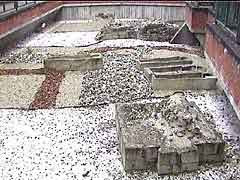
Nunnaminster is buried below the gardens of
Abbey House, at the resident of the Mayor
of Winchester

Celibacy is a crucial, primary feature of monastic life, though I don't see many non-institutional people discussing it these days. It isn't a popular topic among Americans. There are some folks on the internet claiming to be independent monastics of some sort, calling it by various terms, including monikers such as "anchoress" or "hermit" -  while at the same time living with spouse and children and conducting an active sex life. Monastic life is a solitary life that is sometimes lived together among others who are ALSO living a celibate/chaste life, which is known as a "cenobitic" arrangement. Sex activity is not part of the deal!

Most hermits I've read about do not spend their entire lives in that state. It seems to be a type of life to which some religious folk resort for a time certain, and then they return to a more active life or, as in the case of the Hindu Sannyassinis, it is a lifetime occupation. Even so, followers would often gather around the people - something I discourage, especially since I am not attached to any institution that would support it.

It is clear to me that The Lord definitely intends for me to live this life for the duration because my circumstances keep trending in that direction very strongly. For instance, the constant aggravation with the caregiver situation. Although I was approved for a caregiver at least 2 years ago, I have yet to find one. There is a terrible dearth of "caregivers" in general, and ALL the agencies are scrambling to try to serve their clients.  I have had some terrible experiences with agencies. The people either do not show up at all, or show up whenever they feel like it, or show up drunk or stoned, or show up and tell me they are disabled and can't do any real work, or show up and steal from me - or some combination of the above.


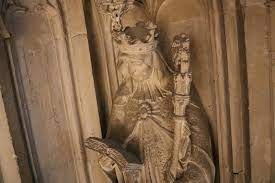
Saint Ealhswith's statue at Winchester

Today, the 3rd day of a new caregiver, she was late for the third day - in other words, late EVERY day - but today she is refusing to give me the simple courtesy of a phone call to tell me that she will be late. 

Not only is she refusing to give me a simple phone call to advise me she will be late, but the schedule we agreed upon has VANISHED somehow, in lieu of which, she expects to wander in here at some point after dusk - whenever her other activities allow, which definitely does not work for me.

The work that she DID manage to do was sloppy, not to requirements, not in accord with what I asked, and in some cases she ruined some things which had to be thrown out. I am having to re-wash all the dishes, including the blender, which I showed her how to clean. When I brushed my teeth this morning with my battery-operated toothbrush, the unmistakable flavor, scent and pucker of Ajax chlorine bleach powder hit my nose and my taste buds.  It was horrifying. The taste of some kind of filth also lingered, and I became convinced she had either dropped my toothbrush onto the floor or had used it to clean the grout in the sink (something she denies.) I rinsed and rinsed and rinsed and rinsed, then I gargled with hydrogen peroxide. And repeated.  I had a headache the entire day.

Every time a new "caregiver" is slated to start, I prefer to think well of them. I try to find whatever seems good about the person. It makes me happy to do this, but, conversely, when it does not work out, it may be that my initial assumptions work against me and make me feel more disappointed. I always start with high hopes. There is something odd happening with certain types of service jobs. There is a name for this tendency to abandon service jobs in favor of others that allow you to work at home or that may pay more. Covid started it, but I believe our nation's steep disparity of income that has increased in severity since the 1970's is to blame.


DISPARITY OF U.S. INCOME
1970 through 2005
Data from the Dept. of Labor


The first question that goes running through my mind is; Why do these people have such a crappy work ethic?

But the second thought is the understanding that this is just another way of the Lord enforcing my hermit state but unlike a hermit with institutional support, I am just as alone over here as the Desert Mothers - and perhaps MORE so. I am not without friends. Don't get me wrong. I have some lovely friends, but they have husbands and families and live on the other side of town.

After two years of disruptive irresponsible "caregivers" coming to my apartment and wasting my time training and instructing them, only to find myself shat upon in one fashion or another, I am resolved to TAKE THE HINT and give up on the idea of a caregiver. (Face it - the caregivers have given up on ME, really. It is silly to pretend that I can CHOOSE to give them up, since I can't seem to keep one here.)


Because I am physically disabled and cannot keep up with dishes and cooking, and because this is the main source of the mess in the apartment, aside from the paperwork that has gotten away from me, I need to figure out a completely different method of getting myself fed. I may need to eat at a restaurant every day.  I really don't know. How could I AFFORD that? It seems unreasonable.

If I lived near a health food restaurant or store where I could pop in and have something to eat quickly every day, that would be ideal - if I could figure out how to afford it.

Even CANNED food has to be heated up in some utensil, and then bowls and spoons involved, etc. Likewise a salad involves washing and cutting, and then cleaning of bowls, plates, flatware.

Frozen meals used to be affordable, but they're not, really, especially since the electricity keeps getting shut off over here, endangering the safety of eating food that has been partially defrosted and then re-frozen again.

I thought about making smoothies, but those also involve washing and cutting of the fruits, assembling the blender, making it, then taking apart the blender and washing it and the glass that I use to drink from. All of these activities require a certain amount of standing for prep work and dish washing that I just can't do. 

This topic stimulates some lovely memories I have of when I was a nun in a Vedanta (Hindu) convent in California and I often volunteered to do the cooking part of the work schedule that the younger nuns had to do. Cooking is a marvelous way to demonstrate to others a certain care for them and is an aspect of loving service that we all NEED. Feeding someone literally keeps them alive. It is hard, now, to be so physically compromised that I cannot even cook for myself, much less in service to others, but it is important for me to learn to surrender to the reality of the situation. I do my best to be a light burden on others, at the very least.

Now, if I was Saint Ealhswith, I would never have to worry about how to feed myself because others would be doing it for me. She was a queen, a station of life that relies on a model in which one person gets served by dozens of people, which is rather more the opposite of monastic life. It is fascinating to me that I am descended from so many kings and queens because that life is certainly different than the one I have led!


Saint Alfred the Great


I am going to bring this to the Lord and ask HIM to fix it up for me. After all, HE is the one who has made me THE ACCIDENTAL HERMIT. It is up HIM to fix it. Isn't it?

Or shall I just retire the kitchen cooking supplies, give up all food prep and struggle on? I don't know.  Saint Ealhswith, my grandmother, please inspire me today and intercede for me at the foot of God's holy throne.

May we all be blessed!

Mother Silver Rose
Sannyasini Kaliprana

P.S. All of the blog posts I write are independently researched and written by me and all of them are protected by legal copyright, so please just enjoy them here and leave them here where you found them and do not copy any of it to any other place for any purpose.

(c) Copyright 2022, Silver S. Parnell
All rights reserved.

Wednesday, June 22, 2022

THE CULT OF SPIRITUAL PERSONALITY - June 22, 2022


Lady of the Stars
by
Silver S. Parnell
(c) Copyright 1997
All rights reserved.


This topic is far-reaching and has affected my life dramatically, so this post is a bit of a ramble, and I hope you'll forgive me for that, but this IS a diary and there are days when the events of the day intersect with my chronic illnesses and the mental processes and developments that occur, on occasion, with someone given over to a great deal of mental prayer.

Not Seen but Felt

There is an unseen reality of the spiritual universe that we sense is there, even when no one has told us specifically that there is such a thing. The physical world and its goings on sometimes hint at it but my experience is that some people correctly perceive the yearning to dive into it as a yearning for God and others are more confused. They try to find God in the emoluments of the world, and this is why we are warned constantly, in all the religious traditions, really, not to look for the Divine in the transitory things and doings of the world, but to "dive deep."

I sometimes find that people whose business it is to advance the spiritual objectives of humans and who ought to be examples of holiness have personalities and habits that point in another direction. This week I've run into a few of these folks, and I'll explain later, but first I offer today's Gospel reading, which just happens to give Jesus's point of view about this topic:

Jesus said to his disciples:
"Beware of false prophets, who come to you in sheep's clothing,
but underneath are ravenous wolves.
By their fruits you will know them.
do people pick grapes from thornbushes, or figs from thistles?
Just so, every good tree bears good fruit,
and a rotten tree bears bad fruit.
A good tree cannot bear bad fruit,
nor can a rotten tree bear good fruit,
nor can a rotten tree bear good fruit.
Every tree that does not bear good fruit will be cut down
and thrown into the fire.
So by their fruits you will know them."
~Matthew 7:15-20~

The Fruits of the Holy Spirit

Even Children with no exposure to religion, have a sensitivity to these fruits of the Holy Spirit. Goodness is obvious to their innocent souls. In fact, children often experience this world of the spirit very profoundly, and that is why we sometimes marvel at the suddenly wise things they will say, on occasion, between doing stupid things that will get them killed, of course. Even in households completely devoid of spiritual or religious thought, such as the one in which I lived, their pure hearts will be tuned in the movement of the Divine that they sense underneath everything else. They don't have the language for it, of course, but the experience is there. I remember the lovely experience of just being that comes upon us when we are quieted in nature. Eventually we are given to understand that it is God.

The Scientology Cult of L. Ron Hubbard

I seem to have been born interested in God, but I was raised by abusive people who hated religion, so of course the first thing I did when I left home was to fall into the first religion I encountered, which was the cult of Scientology. I ended up doing a "special mission" for the founder L. Ron Hubbard on the Scientology "Sea Org" flag ship that traveled between Spain and Portugal, with regular stops at the Canary Islands and  Portugal's island of Madeira.

My strongest memory of Hubbard was that he had a bevy of nubile, young "messengers" who hung on his every word and waited on him meticulously. In addition to running messages from one end of the twin-screw motor yacht to the other, they did all kinds of personal errands for him and were ready at hand when he needed his tobacco lit. 

The thing that alarmed me was that the young teen's uniforms were extremely tight, with derriere and décolletage nearly bursting out. It didn't seem appropriate because it pointed away from the divine and to the world of biology and crass material instead. After getting to the "heart" of that group and finding that its emperor wore no clothes, I remember thinking, "well, this isn't it!" It took me a another six months to escape THAT group. First, I had to get off the ship!


View from El Dorado Hills
California, 1995
(c) Silver S. Parnell
All rights reserved.

Cults and Sexual Perversions

I also got a chance to watch friends and acquaintances make some unusual choices over the years. When I was in my early 20's, I worked for an attorney from an office on his property. He and his family were marginally involved with an old Indian man whom everyone called "Father" who had 7 young American "wives" that he had conned into buying his  self-serving, sexually perverted version of "Hinduism." It was a tiny little cult and it was weird. I happened to see that old man lay a big French kiss on one of his young "wives" and it revolted me. I remembered thinking, "I've gotta get OUT of here." Shortly thereafter, my boss died in a bizarre auto accident, and I moved on.

All Religions Subject to Clericalism

Something that all religions had in common, no matter the degree of legitimacy or cultishness, was the tendency for the devotees to practically worship every authority figure.  This was regardless of whether or not the spiritual celebrity warranted it, i.e., whether or not he or she actually followed the precepts of the faith and met general expectations for being a good human.  This sort of thing happens in every organized religion.

I have seen a certain degree of it recently in the Catholic Church, though "clericalism" has, admittedly, become a little less prevalent than it was before the pedophilia scandals.


Swami Swahananda
Hollywood Temple 1980's
(c) copyright Silver S. Parnell
All rights reserved


Meeting a Legitimate Saint

When one has known a person of legitimate spiritual bona fides, it is easier, later on, to identify the wolves in sheep's clothing when you meet them. On my spiritual journey, I have gotten to know people whose spiritual character was a wonderful example to others and who more than deserved the devotion that many of us had for them. One such person was Swami Swahananda. He seemed always to be absorbed in the Divine. Even when he was telling a joke, I would see him drop back into it quickly. By "it" I mean that vast unseen reality that I had been aware of since I was a kid. He would tell his silly joke and enjoy the laughter, and you could see it in his eyes, that he "returned to zero." He was wonderful to be with because he never tried to drag me into conversations of things that did not matter, such as what the other women would often do. While the nuns were absorbed in whether or not I would lose weight before entering the convent, for instance, he could not care less.

Nothing in the perceptible world missed his notice, of course. He wasn't blind. It's just that he was so established in the enduring reality of the unseen spirit that he wasn't going to waste his time dealing with things that were transitory. How much my body weighed was not on his list of stuff that matters because my body was the least interesting thing about me. He saw my nature, and I saw his, and we had a wonderful friendship. Every once in a while he would imitate the pinched face of one of the nuns as she delivered her scathing criticisms of me, and we would both be overcome with the giggles, despite the fact that I was being positively roasted by the good lady nun. It drove them mad that I did not take their criticisms of me in a serious vein.


Swami at the beach, Kali Puja Immersion day


Ignoring his spiritual stature and only watching the way a close handful of people clung to him, a jealous woman used to speak disparagingly about the swami. She represents the other side of the coin of the cult of personality because she ALSO judged him on the basis of something other than his character, but in her case, she disparaged him, whereas most people obsessed with personality instead of principles almost deify their leaders, while ignoring their wretched moral and ethical behavior at the same time.  Same coin. Two sides.

"An honest witness does not deceive,
but a false witness pours out lies."
Proverbs 14:5

Every religious tradition I am aware of has a prohibition against lying, except perhaps the Scientologists. I seem to remember some written policy that says that if a lie is going to protect the survival of Scientology, it is OK to tell it. I don't believe in that idea for the preservation of any religion, but I also do not consider Scientology a religion because, while I was in it, they were talking about how ludicrous it was to suddenly start talking about God but that they had to do it in order to get a tax-free status. "God" played an extremely minor part in their philosophical discussions. The existence of God was acknowledged but I never heard a discussion of Him. He was in the background somewhere, I suppose.

One's moral and ethical behavior, and the gifts of the Holy Spirit are the calling cards of the soul. They tell you everything you need to know about a person. Swami Swahananda's ethical and moral life was beyond reproach. I have almost no criticisms of him, and none of the ones I DO have are important.


It is sad, really, that the beauty of the Lord is right here for the taking, and people waste their time on externals and petty egotistical squabbles. Jesus said that the kingdom of Heaven is among us, and I think that he was trying to get our minds off the gross stuff of the physical world and establish us in the spiritual world with HIM because Heaven is among us when HE is among us. He is among us when we incline our minds in his direction. It is very simple, really.

Balancing Body and Soul

It's a balancing act between body and soul. Humans have too much attention on the gross and not enough on the subtle planes.  We ARE body and soul, but a lot of people behave as if the only thing that matters is the physical plane.

The physical world has to be dealt with, of course. I think it is in this physical universe that we are meant to demonstrate the spiritual lessons, and it is important for that reason. If the world was completely unnecessary, God could have simply made us and kept us in heaven with himself. We are made to learn something in this world, but we are not meant to think of it as the be-all and end-all of existence. We are here for some time, doing what we do, and then we return to Him if we don't ruin ourselves here. 

By the way, all of this, the way I have expressed it and my perceptions about it are my own and do not represent any official religious interpretation of scriptures, theology or anything established by any church. I am only describing what I have experienced but I am not setting myself up as an authority for anyone else.

Meditation is Common Among Many Religions

While I have studied and experienced many religions, I was lucky to have stumbled across Vedantic Hinduism because everything was different after that. The meditation practice is really wonderful, and I was lucky to have had a relationship with someone established in the spiritual reality who deserved to be lionized a bit.  I feel grateful to have been his student and to have taken Sannyas (monastic) vows at his feet (many years after leaving the group.) After learning from him, it became easy for me thereafter to make an assessment of other spiritual personalities and people in general.


Twelve Bad Marriages at Once

I first heard about contemplative monastic life when I was 11 and, in a real fluke, started corresponding with a convent of Catholic Carmelite sisters. My mother had an absolute fit and objected, and that was the end of THAT. I stuffed my desire for monastic life until much later, when I discovered Vedanta and really fell in love with Vedantic meditation. 


A perverse person stirs up conflict, and
a gossip separates close friends.
~Proverbs 16:28~

It wasn't long before my monastic inclinations rose up again, and I found myself in the convent, after a grueling period of hazing by the nuns. I just could not understand their antipathy. If only there were spiritual personalities like Swami Swahananda in the convent, I might have stayed forever, but those nuns tormented me with a constant stream of petty criticism, gossip and superficial nonsense. I hadn't a moments peace.  It was like 12 bad marriages at once, and it shocked me because I expected at least a minimum of the divine attributes. I was not expecting it to be like returning to high school. It was mind boggling. No matter how hard I tried, they continued to torment me.

An example of someone's behavior being the opposite of what one would expect of a holy person:

I hurt my back working for them, and one of the nuns marched down to the swami to inform him that I was "faking." It was a lie, of course, but I cannot honestly tell you what this was all about. Why did she do that? Why did she even think such a thing? Why, after decades in a convent, does a senior staff member make something up out of whole cloth, and why, for the love of God, did she not have a speck of love or compassion in her for someone who was suffering? I was in a LOT of pain and had to be in a wheelchair half the time. 

Today, I am fully disabled, with chronic pain and debilitating arthritis. A lot of what I suffer is due to the hard work I did in that convent and the arthritis that began during that time. Clearly, I wasn't "faking" it, as the X-Rays tell the whole story.

Lies and gossip are signs of suspect motives for joining a religious group:

One funny story:  Apparently, they were telling all the devotees that I was eating all the chocolate in the pantry, and then the snootiest nun went on vacation and the chocolate just sat there. I had NO idea any of this was going on because I don't like chocolate very much and will only eat it if I am having a very strong urge for something sweet and my choice is either nothing or chocolate. They never spoke to me about any of this and I had been told I wasn't allowed to speak to the devotees, so none of them told me that the nuns were spreading rumors about me.  All I knew was that there was this roiling underlying tension and energy all the time which literally made me ill.

Lies and Gossip Follow Their Target for Years

When I left the convent, I was very lonely. I had spent years living with people who behaved with hatred toward me, so I soon thereafter started dating one of the local men, and, before I knew it the nuns were saying that I had been secretly dating this man while I still living in the convent! A complete lie. I am not capable of this, nor have I done anything similar to it at any time in my life. Whoever started the rumor knew it was a lie. They knew that it was something they had invented. Lies are just the worst.

I often tell folks that THIS habit of women toward jealousy, gossip and lies is why men are in charge of the world.

Being Alone With God is Sometimes The Only Route to Take

Hearing about those lies, years later, was validation for my having left the convent. When you go to place so that you can get closer to God, and all the people living with you are immersed in lies and ill-will, it becomes impossible to do the very thing you came there for to begin with. Living now as a hermit, I have much more spiritual companionship than when I lived in that place, surrounded by supposedly holy women - or at least women who had presented some sort of good intention when they arrived.

After leaving the convent, one of them admitted to me that they had all been afraid that I would "rule the convent from the bottom" because I was close to the Swami. They hounded me out of the convent due to that jealousy and fear but none of it had anything to do with me. It is a terrible shame because I loved convent life, but after 20 years as a hermit, I recognize now that the solitary path is probably my destiny, if not what I wanted for myself.

Many of these circumstances led to my going to the Catholics. I thought SURELY Catholic organizations are better ordered. But now I am not so sure. I think perhaps people are the same everywhere and that the saints are just those people who actually follow the religion.

All these experiences taught me a LOT about human beings in religious institutions. So YOU get to benefit from my distressing experiences. I bring a lot to the table in this regard.


Swami Swahananda
making a point during class
(c) Silver S. Parnell
All rights reserved


Motives for Joining an institution or profession Vary

Something that happens in spiritual life and in politics is that callow individuals seeking the status of celebrity and the power that comes along with it, will pursue advancement in convents, monasteries and other institutions and they use the credibility of those institutions to paint themselves in a more respectable light than what they would typically earn on their own. The problem with this is that these people damage the reputations of those institutions that they use in this way. 

We have examples of this in many fields. For instance, in politics, we have a cynical con man in Donald Trump, who has destroyed the reputation of the Republican party. In the spiritual field, the first thing that comes to mind are the many pedophiles that have used the Catholic Church as "cover" for their vile activities.  People have been known to murder for profit, and then hide behind religious robes, a police uniform, or a political position.

The many saints that I write about in this blog have our respect because of their spiritual character. They are reliable witnesses to the faith in what they do and say. Wearing a costume or having a title is irrelevant. They are called "Saint" because of what they do and say and not because they wear a religious garb.


Farmland in Placerville, CA
(c) 1995, Silver S. Parnell
All rights reserved.


Choosing to be Intentional When Choosing One's Associates

We live in an era in which wolves in sheep's clothing have multiplied dangerously. We have to watch people very carefully and do not give them our allegiance or lend them even our attention until we have ascertained that their character warrants it. Are they truthful? Are they kind? Do they follow the commandments of their faith? We need to be more deliberate and intentional when allowing people into our lives, hearts and minds.

Obviously, I am not saying that perfection is required but with respect to LIES, in particular, there is no way to accidentally "lie" because when you invent a lie, you know that you have done this deliberate thing (unless you are insane, which is a different problem!) When a person lies, they are choosing to do evil. I think this is why it is said in the Bible that Satan is the father of all lies.

Perhaps this is why lies bother me so much. The person knows it is not true, but they say it anyway.

Generally speaking, the person's actions should typically tend toward the attributes described as the "fruits of the Holy Spirit" in St. Paul's letter to the Galations, which are: 
Love, 
Joy, 
Peace, 
Patience, 
Kindness, 
Generosity, 
Faithfulness, 
Gentleness, 
and Self-Control.

These fruits of the Holy Spirt are shared, in other forms, with the philosophies of Buddhist and Hindu faiths, as well as others. 

There is a nice article about these at the following link:


It occurs to me as I write this that it would not be a bad idea for me to list these 9 fruits and post them somewhere prominently to remind me, in my daily self-examination, to compare my behavior and thoughts to this list. Taking this list in hand and comparing the actions of supposed leaders and "holy" people is a pretty good idea also.

Another thing to watch are those infernal memes on Facebook and elsewhere. Don't absorb these obnoxious, simplistic maxims unthinkingly. Many times, the person to whom a quote is attributed has not had those words come out of their mouth or their pen. Sometimes, the quote makes no sense outside of the larger document to which it belongs. Most of the time, these pat little memes get their energy from some type of criticism of others that is toxic. Many times, the memes appeal to an underdeveloped ego that looks to make itself feel superior to other humans, and if we take these ideas on board, it will be deadly to our spiritual development.

A few days ago, I read a long quote from a supposed homily of Pope Francis that a nun living in a convent had published to the internet, with her own enthusiastic recommendation for the supposed wisdom of the words. Immediately, I could tell that it was a fake. It spoke in a way that was not our Pope's manner of speech, and the underlying ideas were "New Age" in some spots and Calvinistic in others. A quick Google search proved my suspicions were accurate It was an heretical post. Memes like this are spiritual poison for the soul.


Pope Francis recently meeting with Buddhists


I attached a link to the post of a journalistic article about this spurious "homily" and sent a private message to the sister, asking her to please remove the post because it was fake. What she did instead was to immediately remove me from her "friend list" without a word in response. I was unable to communicate further with her. I suspect that a religious who behaves this way has perhaps chosen her vocation for the wrong reason.  Who knows? In any case, her behavior was wholly inappropriate.

It used to surprise me when people behaved in this way. If was told I had published a fake quote to the internet, I would have THANKED the person and removed the post. I would be grateful to have the truth.  But for some people, the truth is not something in which they have much interest. Other things, like their ego needs, are more important to them.

You find this sometimes with people who start groups online as well. They use the groups to satisfy ego needs that have not been met. Today I joined a group modeled after Bede Griffith's ashram-style Catholic institutions. Bede wrote  some WONDERFUL books, and I felt a great kinship with him when I left the Hindu convent to become Catholic, but the one comment I made on a meme in today's Facebook group was met with such rudeness and snotty arrogance that I immediately left the group. (It wasn't Bede Griffiths that did this. He died years ago. It is some man with whom I have no experience except his rude response to a comment I'd given considerable thought. .) I wanted so much to talk with people of like minds, but everywhere is pretense and posing instead of authentic spiritual interest.


Fr. Bede Griffiths, a Catholic Sadhu
I took the same type of vows and wear the
same color, when it is available.

Bede Griffiths books are just wonderful. He is a very deep thinker, and anyone interested in contemplative life will find him interesting, I believe. On the following link, there is a clip of a lecture of his:

Fr. Bede Griffiths

With regard to fake memes on Facebook

Many years ago, a former friend with monastic aspirations posted an even more noxious meme that ALSO had a picture to accompany the fake story. The picture was of some other person and not the "pastor posing as a homeless person outside his church" that the fake "true story" claimed. The meme targeted Christianity and made the point that Christians are hypocrites. While some Christians ARE hypocrites, I am sure, it is not right to negatively paint the entire faith with a lie.

Here is an article about the fake meme that she used:


This is the photo from the fake meme. It is
supposedly "Jeremiah Steepek" but is
actually a photo of an English homeless man

When I approached that former friend about the lie she was perpetrating, she became extremely hostile, called me names, made up stories about me and my supposed motives, and was generally vile. It does not matter how polite, how correct, how loving the method by which you approach these kind of people because approaching them about their dishonesty enrages them. At least, that has been my experience - and the reaction is particularly strong if the person has some kind of monastic aspiration or has a yearning for another type of celebrity.

While we have to watch these people carefully, and avoid internalizing whatever dishonesty they are peddling, I wouldn't walk through life with suspicion. That would be exhausting and of little or no benefit. I would just say to continue to behave with respect and deference toward ALL humans but to just be very careful about what ideas you take on board. Guard your soul from trojan horses filled with toxic dogma.

I have witnessed circumstances in which philosophical concepts that are allowed to sink into our soul without challenge or examination can wreak havoc down the line. A LOT of people believe fervently in a few popular "New Age" theories that directly contradict the Catholic faith, for instance, and they are unaware of it. I am not saying you cannot have an independent thought. I am suggesting that you ought to KNOW that it is an independent thought!

As far as the spurious memes that are endemic on Facebook, you may decide to do what I have decided to do, and that is to curtail my Facebook activity. I'm not joining any more groups, because you never know who is sitting at their computer creating these "Catholic" groups without having any bona fides to back up their "leadership." And I am going to resist the urge to make comments on other people's posts, unless it's about animals or art. I can't go too far wrong there.

The final comment on which I want to end is to turn around all the negative experiences and reframe them in the positive which will be obvious, but I feel that I am not doing my job if I am not pointing toward the Divine, rather than the absence of the Divine - because that is EXACTLY how I have learned to cope with all the negative experiences I have had around this topic, with people who should have loved me but worked to make me miserable instead.  

Here is what I want to say: even if there is no one in your arena who exhibits the fruits of the Holy Spirit, that is perfectly fine because we ourselves can turn this around and do my favorite thing, and that is "incline the mind to God!"

We can get going with our mental prayer and turn this into a 9-day novena and meditate on one fruit of the Holy Spirit each day. Isn't that a good idea? By meditating on the fruits of the Holy Spirit, it will help each of us develop those characteristics within ourselves, and we can radiate it out to the universe. 

As usual, all situations devolve into a call to become better ourselves, and I hope you join me in the effort. Let me know how this works for you, if you decide to try it, won't you?

May God bless us all!

Silver Rose