Saint Olga of Kiev, my 34th great grandmother

Saint Olga of Kiev, my 34th great grandmother
SAINT OLGA OF KIEV, MY 34TH GREAT GRANDMOTHER
Showing posts with label Catholic mysticism. Show all posts

Tuesday, October 15, 2024

THE IMPORTANCE OF THE SUPERNATURAL, THE MYSTICAL, THE CONTEMPLATIVE CHURCH


THE TRINITY
BY TADDEO CRIVELLI
(From a manuscript created about 1460-1470)


Social Media is an opportunity to evangelize:

A non-Catholic on Facebook says that, although she is not Catholic, she has been reading the Bible, reciting the rosary, praying, and doing other very "Catholic" things, yet still feels empty. As I wrote my response to her, I realized that I was explaining to her not only the reason for my becoming Catholic, but some of the significance of the supernatural and mystical nature of our faith which is accessed by contemplative practices.

My response to her gives a strong explanation of why I became Catholic.

This is what I told her:

"The Catholic faith is not an intellectual exercise. What do I mean by this? I will give you one example. In John 20:19-23, Jesus appears to the Apostles after the Resurrection, satisfies them that it is, indeed HE who stands before them, and then tells them that, just as God has sent Him to them, Jesus is sending the Apostles out to mankind. Jesus has the POWER, as well as the AUTHORITY, to do things under God the Father's power, authority, and direction. Then He does something very significant.

He breathes upon them. What is the significance of this? It is the TRANSMISSION of the power to do those things that God, the Father has directed.

It was not enough to simply HEAR from Jesus that the Apostles have permission and authority to do those things that the Jews always taught that only God, the Father, could do (forgiveness and healing, among them.)


Power was transmitted to the Apostles


Jesus had to transmit POWER to them in order for the Apostles to have the ability to do what Jesus instructed. This is why He BREATHES on them. If simply telling them were enough, He would not have BREATHED on them as a dramatic action.

The POWER is an actual "THING" (for want of a better word.) It is not an intellectual assent or an expression of PERMISSION. It would not have been enough to give them PERMISSION to forgive sins. He had to give them the POWER to do it!

Upon breathing upon them, Jesus announces to them what He has done, "Receive ye the Holy Ghost." The spiritual gift, the spiritual power, of The Holy Spirit has been transmitted to them by Jesus, whereupon He tells them what they are to do with this power that was transmitted to them.

"Whose sins you shall forgive, they are forgiven them: and whose sins you shall retain, they are retained."


Apostolic Succession:

Down through the ages, the priests of The Holy Catholic Church have received this Holy Spirit, this POWER, in an unbroken line from those early days. This unbroken line is "Apostolic Succession." From God the Father, to Jesus the Son, to the Apostles, and then down through the long line of bishops (our modern "apostles"), the power of the Holy Spirit travels.


This power was not transmitted to other churches

There is no other Church that has had this power transmitted to it directly by Jesus.

Only the Apostles who formed the Catholic Church were breathed upon by Jesus. The Jews did not accept Jesus as the Messiah, and they did not receive it.

The "Eastern Orthodox" Church started out as the Eastern arm of The Catholic Church, but they would argue that we broke off from them. The Eastern Patriarch excommunicated our Pope and our Pope excommunicated the Patriarch of the Eastern part of the faith. The great Schism between the two halves occurred in 1034, and our territories are divided, East and West. I believe they are considered to have apostolic succession.

(When I became disabled and home-bound, I decided to dedicate my prayers, in general, to the reunion of all Christians, especially the Catholic with the Orthodox churches, so I have a heightened interest in my Orthodox brothers and sisters.)

The so-called "Protestant" churches would not exist for another 500 years after the schism, and they did not receive the breath of the Holy Spirit. They rejected the Church that Jesus started and decided to start their own.

In 1517, Martin Luther posted his objections to the Catholic faith on the Church door, in Wittenberg, Germany, and by 1521, he had left the Church entirely, and that was the beginning of the Lutheran faith in the Germanic countries.

I read something the other day about him taking up with a nun. They fell in love and decided to violate their vows. Instead of admitting what they had actually done, Martin Luther found fault with the Church instead. Not a great pretense on which to abandon the true faith of Christ.

Thanks to Henry VIII, King of England, the English abandoned the Catholic faith for "The Church of England," which was created so that King Henry could marry multiple wives. He issued his Act of Supremacy in 1534, claiming headship of the Church in England.

It is sin and ego that separated out these movements from The Church that cradled them from infancy. We often think we can do better than our Leaders and our betters, thanks to egotism.

Ours is a profoundly supernatural, relational, mystical faith. It administers the intersection of the supernatural with the natural, to beings who are both "body and soul."

A meal you have not eaten cannot feed you.


So far, you have been watching a meal being created, cooked and eaten by others. You see the benefit of it. But you will not receive any of the nutrients, vitamins and minerals from that meal you have not eaten. You can agree that eating that meal is a good thing to do. You can give assent to the goodness of it all you like. But until you eat the meal yourself, none of the vitamins or minerals of that meal will sustain you.

Your soul will be starving until you join the Catholic Church."

The error of human beings does not adulterate The Faith.

All my life, I had searched for the mystical connection with God. I knew, instinctively, that there was such a thing, and I felt, at times, that I was experiencing a hint of it within my soul. Throughout my childhood, I had heard nothing but bad things attributed to the Catholic Church. Everything I had heard about it in popular culture painted a picture of an institution that was staid, rulebound, judgmental, and (at times) cruel and militant.


The Catholic Church is the repository of the supernatural, mystical gift of Jesus Christ.

It wasn't until I was a nun in a Hindu convent, where I EXPECTED to find the mystical heart of God and the universe, that I actually found it in the numerous books I read about the Catholic mystics. Saints Theresa of Avila, John of the Cross, Jane de Chantal, Francis de Sales, and many others opened that world to me. Eventually, I left to get baptized and be accepted into the Catholic Church.

I HAVE found some people who were staid, rulebound, judgmental and, at times, cruel and militant - but The Faith is never thus. Human beings are flawed, and people are limited in their ability to express The Faith, according to their own temperaments, gifts and deficits. Their interpretations of The Bible, or The Catechism, as they relate to the faith, can be limited to only what their temperament will allow. But The Lord, true to His Word, has kept The Faith intact, down through the ages. He promised that "The Gates of Hell" would never prevail against it.

Some people emphasize the Temporal while others focus on the Mystical:

There are some people who reject the metaphysical aspects of the faith, while others reject the practical and temporal. But, just as human beings are "body and soul," so is the faith comprised of both these aspects. We are expected to perform certain actions in and for "the world," while at the same time being informed by and operating within The Spirit. When we do not properly incorporate the world with the spirit, we can develop a mania for one or the other.

There are people who are so transported by stories of the supernatural, that they lose all sense of the practical and worldly altogether. They seem to be gullible to every so-called "apparition" that is advertised, no matter how outlandish it seems to most of us. This is not helpful to the faith and can cause charlatans to take advantage of well-meaning folks. Some of the Catholics who are focused on the supernatural can be dismissive of the practical aspects of the faith. The allurements of the mystical consolations captures their attention so much that they will pursue the entertainments of it and will follow "seers" whose monetization of the faith will appear as if the circus has come to town.

Sometimes, in pursuit of the mystical attractions, the plight of suffering neighbors will be ignored, and we will fail to feed the hungry, clothe the naked, and do all the other things we have been commanded to do in order to love our neighbor properly.

On the other hand, folks who are focused on the worldly aspects will be very good at the practical matters. Unfortunately, some of these folks will eschew anything metaphysical. It makes them uncomfortable. They are afraid they will not be taken seriously if they even talk about such things in relation to The Church. For instance, the apparitions of our Blessed Mother can make these kind of people very uncomfortable, even though there is very solid evidence for them. The apparitions at Fatima, Portugal, for instance, were reported in newspapers around the world, complete with photographs of the Miracle of the Sun. Skeptical reporters had gone to that location to debunk the miraculous, only to return absolutely converted, and bring home the proofs of the miraculous they had witnessed. Many thousands of people were eye witnesses.


The current trend:

In the last three decades or so, it seems to me that many parishes have rather more of the latter type of person running them. It feels as if the secular expectations of how to run a business have taken over, and the mystical is regarded with suspicion. This does not mean that "The Faith" or "The Catholic Church" is anti-mystical. It only means that the people administering many parishes, at the moment, have generally more of this tendency. It is my hope that, gradually, it will move to the center position, where both aspects - spiritual and temporal - are blended equally.

Humans are not perfect, but it is my belief that most everyone is doing the best they can, given their personal interpretation of the light that has been given them by the Holy Spirit. That does not mean there is no room for improvement, and one of my prayers, lately, is that the spiritual and temporal be interfaced with one another in the way in which Father, Son and Holy Spirit want them to be. "The Trinity" itself is a perfect example of this Divine, Blessed Balance!

Pray for your parish and your leaders!

If you find any deficit with the parish in which you find yourself, let it be a reminder to pray for the leaders of our faith. When you are praying, don't forget to mention your parish and fellow Catholics. In addition, I offer the following prayer:

Loving God, author of creation,
your spirit pervades and enriches our
world.
Through your Son, who shares our humanity,
You have called us to participate in your divine creativity
and to build the kingdom of God here on earth.
Form us, we pray, as one community
under the leadership of our bishop
to serve all the people of this region in your name.

Inspire us to discover new ways
and structures to spread your Gospel.
Open our eyes to see Christ in others,
especially the poor, the sick and the marginalized.
Empower us to be the hands and feet of Christ
in our parishes and communities.
Help us to welcome all into His embrace.

Guide us in our discernment,
as we pray with Pope Francis
for the vision to see new paths of possibility;
for a spirit of mission that invigorates our every effort;
and for the strength to be unafraid of what is new.
We ask this through Christ, our Lord.
Amen.

Imprimatur: July 25, 2014
The Most Reverend Lawrence T. Persico JCL
Bishop of Erie


I hope you will take advantage of this beautiful prayer and pray it often! Also, that my blog may be of some help to you for yourself and for the enlightenment of those you teach, lead, and inspire in the faith, including your family and your children.

May God bless us all. May the Holy Spirit enlighten us, and May our Guardian Angels guide us!

Silver Rose


Sunday, July 24, 2022

SAINT WANDRILLE, my cousin, July 22, 2022


Saint Wandrille (Wandregisel)
born about 605, died 22 July 668


Saint Wandrille (aka Wandregisel) is related to several of my relatives that figure prominently in his story, though it was hard to find a picture of him. Of course, the 7th century does not have a lot of paintings of minor nobility left for us to look at. The one above is a stained glass window depicting the saint. Also, he is more well known for the Abbey of Fontenelle than his visage. Who knows? Perhaps he resisted getting a painting made of himself, being too religious to allow his face or personality to become the topic. 

If you are interested in the history of the Fontenelle Abby and Saint Wandrille, Wikipedia has some good information HERE


Cloisters and Courtyard
Fontanelle Abbey
Abbey of Saint Wandrille
Saint-Wandrille-Rincon

I had hoped to finish writing this on the 22nd, so everyone could have a chance of reading it on his feast day, itself, but my cousin, Saint Wandrille, proved to be so intertwined with many of my ancestors, that I found I had to spend a great deal more time piecing his story together than I had anticipated. I became fascinated with certain aspects and had to chase the rabbit down several holes - all of which are interconnected in a spiritual rabbit warren of delights!

In addition, as I continue to work on this blog post on the evening of the 23rd of July (and am far from finished) I am rounding the corner on day 3 of the worst headache I've ever had in my whole life. It has been years since I've had such a migraine, and even strong painkillers were of little use. Even after a nap yesterday, a full night of sleep, and rising from bed after noon, and then napping again from 2 until almost 6 p.m., I am still struggling to get a handle on it, though I no longer feel like I am on the verge of death and tempted to write loving farewell messages to everyone.

The stress of having that "caregiver" in my house who was in her own world and not a terribly honest or sincere person, and to be faced with the stress of having to clean up after someone ELSE when I am losing the ability to clean up after myself, has made my stress level skyrocket. I can never do this again. It has been a lesson to me. I will do without a caregiver and, instead, work on simplifying everything in my life.

The advantage of being a hermit is supposed to be the simplicity of the life, but unless one is REALLY isolated, there is the tendency for things to accumulate around oneself.  For instance, the modern cooking conveniences are tempting but, in the end, useless to someone who can no longer actually COOK for herself. Never let anyone convince you that appliances and cookery gadgets take the place of other people doing the actual work. It is a lie. The best thing to do, I have now learned, is to keep very minimal possessions in the kitchen and to eat raw fruits and veg and sandwiches, and perhaps some frozen meals.

Today I had a chat at the mailboxes with one of my elderly neighbors who lives alone after the death of his spouse a year or two ago.  He is not a religious person, but he has also realized the futility of possessions after a certain point in life, due to the very reason I have mentioned. We are too tired to use them!

I have to divest myself of many THINGS that have come to me through the kindness of well-wishers or through my own misguided idea that it would make things simpler somehow.

Also, since I am ACTUALLY alone, and not alone in concert with other people who are cooperating in the work of a place, I have to accommodate my needs in ways that someone living in a monastic institution would not have to do. There may be occasions when I have to eat in a restaurant, for instance.  I am not going to feel bad about it if I have to resort to that. I am doing the best I can.


WEBSITE FOR ABBAYE DE ST. WANDRILLE

When reading about the wanderings of my cousin, Saint Wandrille, and how he so quickly could switch from a courtier to a religious hermit at a location FAR away, and then 4 or 5 years later move again, and then again - the thing that kept being communicated to me is that OF COURSE he was able to go galivanting all over the country: he had so few THINGS to carry with him!

I remember, with fondness, how, when I left the convent and got my own apartment, I sat on cushions in the living room and used folding breakfast trays as my "end tables." I slept on a mattress on the floor. Those were my only furnishings. Now, my creaky old carcass needs all sorts of amenities, just to get to the point where I am able to grab even 4 hours sleep at night, but I experience nostalgia, now and then, for the days when I could make the decision about furniture and it was not made for me by virtue of the condition of this miserable body! I really need to make some changes so that I can make do without a caregiver.

Once, a nun called me "house proud" because I made her put her steaming mug of tea on one of my breakfast trays rather than my landlord's new carpet. I was rather more thinking of the deposit I would lose if there were tea stains on the carpet when I moved out, as I was living entirely on the floor and had no furniture at all. Today, that nun could rightly accuse me of being mired in worldly possessions, that's for sure.

 I mention her now because I dreamt about her last night, as well as some other nuns. It was an odd dream. We were all wearing full-length gerua robes of the variety one wears for formal occasions. I say "formal," because the sleeves were big and wide. It would be impossible to do much with THOSE sleeves! The material was substantial and rustled when we moved.

I was leading us all into another religious institution. It was a very big house. The lighting was low, the mood serene. No furniture at all - but I was leading them into the shrine room where there would be an altar, and I believe I was introducing them to the place. My friend who called me "house proud" in that early apartment of mine was following close behind me, as if she was trying to catch up with me and ask me something. But no one was speaking, and I did not want to talk. All I could hear was the rustling of the fabric of the beautiful pinkish-orange robes. We were bare-footed, so there was no clatter and echo of shoes on the floor.

 It was one of "those" dreams that gave me the impression that I had actually visited with her. When I woke, I wondered if she was alright because it has happened to me many times in my life that when I have a dream that feels like this and it involves someone I know, it is a visitation from a person who has just died, and I do not find out until later that the person has left this mortal plane. Sometimes I get a message from the person that stays with me forever. 

People do not evaporate when they die. There are minds far greater than mine who have lent their personal experiences, intellect, and writing talent to explain it. All I know is that all my saintly ancestors are today as real as they ever were. When we talk to them, they hear us, and they accompany us in our daily trails. They are our holy family. That is all I know, but this is one of the reasons why I research my ancestors and other saints that interest me because they're not dead. The people who lived as hermits, nuns, priests, bishops, kings and queens - who left abbeys and churches, institutions, or long lines of descendants are with us today. The dust of the years may be on the things they left behind, but there is no dust on them!


Blessed Pepin I of Landen (Modern Belgium)
aka Pepin the Elder or Old
Lord of Brabant
Governor of Austrasia
b. about 580 - d. 27 Feb. 640
and his wife
Saint Itta of Metz
b. 592 - d. 8 May 652
My 39th Great Grandparents

Saint Wandrille is something like my first cousin, 42 times removed. He was a relative of Blessed Pepin I, who is my 49th Great Grandfather. I am positing that Saint Wandrille's father, whose name was Walchisus, was possibly a son of Carloman or one of Carloman's siblings. (This is NOT the Carloman of the 8th Century, obviously.) At this point, we just don't have enough information to say concretely how it was, exactly, that Wandrille was the "kinsman" of my great grandfather, Blessed Pepin I, but he was some kind of cousin. That is all we know from the historical record.


Wandrille was educated in the Frankish court in Metz.  He would have been a contemporary of the children of Arnoald and Oda of Metz, all four of whom were sainted (Doda, Itta, Modoald and Severa.) This seems significant to me, as it accounts for the religious seed planted within him so strongly, that later manifested itself. His early companions were all saints!


Saint Itta of Metz
who was married to Blessed Pepin

It's fun to put together the information I've learned in my research about Wandrille with the genealogy research I'd previously done on the court of Metz, as Arnoald of Metz and his wife Oda were my 39th great grandparents! As in other families of such an early era, I found that I was descended from TWO of Arnoald's children: both Saint Doda (Clothilde) and Saint Itta of Metz were my 38th great grandmothers! Doda was married to Saint Arnulf of Metz, and Itta was married to Blessed Pepin I, mentioned above.


Saint Doda of Metz

my 38th Great Grandmother
b. about 584

Wandrille went on to become a courtier who served Dagobert I, son of Clotare II, "The Great." Dagobert was the King of the Franks, Austrasia, Neustria and Burgundy and was my 2nd cousin, 40 times removed. (Again, for those not familiar with my blog, I will explain that the nobility of Europe intermarried so often that I am a cousin to myself 100 times over, it sometimes seems. When you are descended from certain key people, one seems to be be descended from all the royal houses. That's just the way it is. Americans whose families have been in this country since the 1600's and early 1700's are often these types of descendants from royal families.  "The 2nd sons" who did not inherit the titles, thrones and lands of their fathers in Europe, were thrilled to come here and own land in the New World.)

It seems that Wandrille quickly tired of life at court because he retired to become a monk at Montfaucon when he was still in his 20's, in 629. Saint Balderic, my 42nd great granduncle, was his mentor. Evidently, Saint Wandrille had done this hastily, as he'd not gotten approval from Dagobert, who eventually gave the nod. In those days, one had to get the approval of the king for EVERYTHING one did. They did not have the many freedoms to which we as Americans are so accustomed and take for granted as our right. Life at court had its advantages, but in many respects, it was (and probably still largely IS) a golden cage.


Statue of St. Balderic
My 42nd Great Granduncle

Although Saint Wandrille had been married, early on, he and his wife separated, by mutual consent, each of them to retire to a religious life, sometime prior to his becoming a religious and leaving court.  This is a theme that repeats itself throughout the history of our faith. There is something compelling about the monastic life that seems inborn and spontaneous, so that no matter what sort of life one has to live in order to support one's physical being, in the end, it is only God that matters at all, and once the frantic toing and froings of young life, it is natural to focus in on what matters. This is what I have done over the last 20 years, and although some Americans think it "kookie" or bizarre, it is part of a long tradition shared by many religions. We come from God and return to God in some fashion of other, and this process is interpreted variously by the various religions. I am descended from dozens of Celtic and European saints and THIS is in my blood, so it is how I naturally come to feel at home.

After accomplishing one's worldly duties, it almost seems natural to retire and devote oneself to God. This is a theme that Christianity shares with Hinduism, and probably other major religious traditions as well. This touches on a frequent concept in my writings. All the major religions traditions have a great deal in common, from the aims of spiritual life to the methods of arriving at that aim. Each expresses the goal differently, but when we are open to the harmony of all religions, it is quite easy to see. Joseph Campbell did a wonderful series of interviews on this topic, years ago, based upon his books.

The portion of Saint Wandrille's life I'm particularly keen to learn more about is when he went to live as a hermit in "complete solitude" at "Saint-Ursanne in the Jura." It is named for Saint Ursicinus, a seventh-century monk who built at least one monastery (and credited for more, I believe) in that locale and with whom Saint Wandrille must certainly have been acquainted. This is a fascinating tidbit that I hope to chase up later.
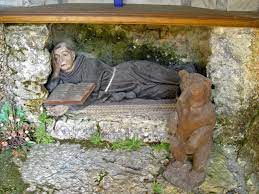


Today, Saint-Ursanne is a small town in Swizterland that maintains a distinctly medieval flavor, with many houses still standing from that era, as well as "a hermitage and an 18th century bridge," according to Wikipedia. I am going to guess that the ruins of that hermitage are most likely built on the premises of the hermitage that Wandrille occupied at the time he was there, in the 7th century, but that is something I would have to research further. Saint Ursanne is one of the MANY places I would have loved to have visited, had I not become disabled so early in life. Every summer, this town hosts a festival for a famous international "hill climb" in August. Thank God for the internet, though, eh? I have to "put a pin in it" and return to this research at a later time. With these rather more obscure topics and smaller locales, research is often limited by differences in language. I do not know any German, and I possess only a smattering of French, so this research may have to rely upon the work or assistance of others at a later time.


The bridge at Saint-Ursanne

Wandrille spent no more than 5 years at the hermitage because, by 635, he was at the monastery of Saint Columban (a contemporary of Ursicinus), at Bobbio in Northern Italy. He also planned to travel to Ireland but never got further than the Tarentaise Valley in the Swiss Alps of France.

After this, he was ordained priest and founded Fontenelle Abbey in Normany. His friend Archbishop Audoin of Rouen advocated for it with Erchinoald, who donated the land for the purpose. It was Wandrille's "last stand" and probably his greatest accomplishment, as it became a center of great learning. The ruins of the Abbey are located near the Village of Saint-Wandrille Rancon.

I would have loved to visit this village also. It is primarily focused on farming and forestry and is situated on the banks of the River Seine, 18 miles north-west of Rouen. Saint Wandrille's Abbey's is his primary "claim to fame" and it is very quaint and impressive, but the Abbey that stands today, in ruins, is not from Saint Wandrille's era, though no doubt built on the earliest ruins. The current façade belongs to the 13th and 14th Centuries and is described beautifully in the Wikipedia page for Saint-Wandrille-Rancon, subtitle "Places of Interest."


Village of Saint-Wandrille-Rincon
at Wikipedia

As I finish the written portion of this blog, I am hearing gun fire not far from where I live, on the banks of the Rio Grande River, close to the area of the "South Valley" where there are a lot of little ranchitos that are very old and quaint. Some of them have adobe ovens outside their homes. I believe they are called "hornos."


You can see the familiar shapes and imagine the wonderful baked goods that come out of them. This area is steeped in history but I have not had a chance to know any of these people, since I moved here after I became disabled, and the lifestyle of a hermit is not a social one. The gun fire is concerning, though, because what goes up must come down.

But I still manage to meet people in the parking lot, as there are more than 70 apartments here. Day before yesterday, I helped a lovely woman with her car and some advice about how to discourage the thieves from breaking into it. She got the car started. In gratitude, she came to my apartment the next morning and brought me a lovely package of home-made frozen chile rellenos. These and tamales are traditional foods that communicate culture and love to those to whom they are gifted, and I am particularly grateful for these. I have a friend who gives me home-made pozole at Christmas - another New Mexico custom!

My headache is mostly gone, so I hope when I wake later on it will have disappeared. Please pray for me in that regard. Also, please pray that I am able to simplify my hermit life in this little apartment in a way that will enable me to care for myself and also follow through with my religious practices.

May we all be blessed!

Mother Silver Rose
Sannyasini Kaliprana

P.S. All of the blog posts I write are independently researched and written by me and all of them are protected by legal copyright, so please just enjoy them here and leave them here where you found them and do not copy any of it to any other place for any purpose.

(c) Copyright 2022, Silver S. Parnell
All rights reserved.

Thursday, June 16, 2022

CORPUS CHRISTI, A MOVEABLE FEAST, AND SAINT LUTGARDIS - JUNE 16, 2022


Corpus Christi is a "moveable feast." Today is the actual day, i.e., the Thursday just following Trinity Sunday UNLESS the Sunday after Trinity Sunday is free from another obligatory feast, which is the case THIS year, but Corpus Christi is such a pivotal and rather important aspect of our faith, that I tend to start on Thursday and maintain the mood through the next Sunday. In fact, the time period between Pentacost Sunday (which marks my entrance into the church) and Corpus Christi, has a deeply personal significance and cause for celebration for me.


Today is one of those days when I really wish that my physical condition was a bit better, just so I could attend church and have the blessing of the Eucharist. Of course, I do believe that, having received it once, it is of enduring benefit, but humans tend to appreciate the blessings that are repeated at regular intervals.

Because of Covid 19 pandemic, I have not tried to get anyone to visit me with the Eucharist on a regular basis. The last person who was bringing it started delivering it with the good news of Donald Trump instead of the day's Bible reading, and I objected to the substitution.


The Gospel reading for today is Matthew 6:7-15 in which He gives us the Our Father prayer and says that it is how we are to pray:


"Our Father, who art in Heaven
Hallowed be thy name
Thy kingdom come
Thy will be done
On earth as it is in Heaven.
Give us this day our daily bread
and forgive us our trespasses
as we forgive those who trespass against us
and lead us not into temptation
but deliver us from evil."

Forgiveness of others is a wonderful message that is obviously extremely important to our Lord. Every time I ask something of God I remind myself to advocate also for those who have hurt me or others. To be able to put aside all resentment and the urge for retaliation is SO important. One cannot always enjoy the idea of repaying evil with good, but I can make that positive decision for it, regardless of feelings.


Every time this topic comes up, I have to work on my own capacity for forgiveness, especially with regard to some really big and shocking things done in a deliberate effort to hurt me and to also hurt my poor father who suffered from Alzheimer's and Parkinson's Disease. His whole life he said, "when I die, kid, you're gonna be rich!" He said it all the time. Provisions in his will reflected it, giving each of his daughters a third of his estate and another third for someone else.  It would have come in handy for someone like me who is disabled, but it is not what happened.

After my father got Alzheimer's he was taken to an attorney entirely unknown to him and I was written out of his will . Shortly thereafter, my poor father died under EXTREMELY suspicious circumstances.  His death certificate was signed by a quack doctor who later went to prison for writing prescriptions for patients he never saw!  I was not notified of my father's death until his body had been cremated, and it was too late for me to get the police involved. 

In the process of trying to get information about my father's suspicious death, I also learned about some outrageous lies that were told about me - to my father before he died, and to family after the fact. Supposedly, I had called and screamed at this person, when telephone records will confirm that this never happened. I DID try many times to reach my father, leaving concerned messages, but I never heard back. I did not realize that my messages were being erased by someone else.  I did not know that my father had dementia or that he was being told lies about me in order to position him into an emotional state that would allow someone else to write me out of his will.  During this time, that person ALSO contacted me and told me, "your father does not love you. He used to have a picture of you by the bed, but he threw it away."

The person responsible for this was obviously trying to manipulate my father (and everyone else) before his death and cover their tracks afterwards.  They were successful in this, as many people are because, face it, Americans don't really care about disabled people or old people. A LOT of people think it is perfectly OK to kill a person with dementia. They say things like, "he wouldn't want to live like that." I know my father really well, and he definitely would not want to be killed. He would expect that people he took care of with the money earned from his hard work would, in turn, take care of him until his natural death. But when the money is rushing out the door for 24 hour, around-the-clock care, certain types of people start to say that "ending his (or her) misery" is the compassionate thing to do.

Every year around this time, I have to endure the emotional distress surrounding the suspicious circumstances of his death. It aggravates my PTSD something fierce. I have this vision in my mind of my father being moved into a room by himself, given an overdose of some medication from that quack doctor, the same doctor who later signed the death certificate, and then he was allowed to struggle and die, alone and unloved. And there is nothing I can do about it because his body was cremated before I knew anything. I was 3 states away, disabled and poor, without the wherewithal to travel to see him.

Imagine the type of personality who could plan and then carry out something like this! Yet, I can freely write about it because it is so common that my description could describe any one of thousands of people who met their death in the exact same way, under the exact same circumstances. These days, our society counts it as a "favor" when disabled and demented people are "helped to die." Doctors are often 'in on' the schemes. The victim typically leaves money and property behind. How convenient.

Given all this, I often feel grateful to be poor. No one will be murdering ME for my money, because I do not have any. I own no property. I leave behind only bills.


To make matters worse, other family members intervened after my father's death and compounded the injury, benefitting financially with despicable machinations originally framed as something supposed to "help" me but which were designed to back me into a corner and rob me instead. This too is quite common. The moment someone dies, it is often the trigger for the worst character traits to suddenly come out by anyone involved. I wasn't expecting it because my mind does not operate in this way. It took me far too long to realize the grift that was being perpetrated on me, on top of everything else. This is the stuff of which murder mysteries are made.

I have learned from this experience and others that human beings "become" avaricious when someone dies. They're like cockroaches scavenging a dead bug. It is a perfect example of why humans need the forgiveness of God and why having money is more of a curse than a blessing.

It is not easy to pray for the welfare of people responsible for heinous acts against myself and people I love, but I can decide to forgive without feeling happy about it. I keep having to make that decision, over and over again, every year around the anniversary of my poor father's death - chipping away, each time, at the tendency for unforgiveness. The happiness I do feel is in obeying the commandments of my Lord. He will deal with the cruel perfidious people responsible for everything that happened to my Dad and all the other dads that meet their fate in that way. Life is short, but eternity is very very long.


The Feast of Corpus Christi is the celebration of the Eucharist, so I plan to watch mass online and take advantage of spiritual communion. I am exhausted from the aftereffects of the booster shot I received yesterday. I can barely move, but I have many things to do. I pray for the energy to do what is necessary.

Saint Lutgardis
b. 1182
d. 16 June 1246

Today is also the feast day for Saint Lutgardis, who is the patron saint for people who suffer from blindness, disability, handicaps, and physical challenges, which is right up my alley, isn't it?


When she was only twelve years old, she was placed in a convent because her family had "lost" her dowry in a failed business deal, and there was no hope of finding her a good marriage. It is SO sad to read these stories about how women were treated as property until a very short time ago. Here in America, for instance, a woman could not have a credit card in her own name until the 1970's, nor could she sign pretty much any legal document without a co-signature from her father or her husband.


In the Middle Ages, when Lutgardis lived, a family had to PAY a man to take their daughter off their hands. Women were considered a burden on the family and, in the case of poor families especially, a useless extra mouth to feed. It didn't matter how much work a woman did in the household. She was never credited with the benefits of it. (To be fair, marriages were more credibly looked upon as the merging of two families rather than just individuals - and love matches were fairly rare.)


The ONE way a woman could be perceived as having any value was when she became a nun, but Lutgardis had little real interest in religion. An attractive young woman who enjoyed nice clothing and entertainment, she lived in the convent as if it was a private apartment, coming and going, hosting visitors, and generally being a scandal.  I suspect this was not an unusual state of affairs, considering the spot that women were in at that time. There were a LOT of children placed in convents who had not the slightest interest in any sort of religious vocation, but living as a nun was better than living in the world as an unmarried girl, which carried the weight of disgrace.


But suddenly, one day, while relaxing and enjoying conversation with a gentleman caller in the parlor, she was struck with a vision of Jesus Christ, showing his wounds to her. She dispensed with the ersatz lover and, from that point forward, she was transformed. Of course, the other nuns were skeptical, even after she made her solemn profession as a Benedictine. But she continued to have many visions of Christ, the Blessed Virgin Mary and St. John the Evangelist. When Pope Innocent III died, he came to her to thank her for her prayers and sacrifices that she had offered for him while he was still alive.


Pope Innocent III


I love this story of Lutgardis being visited with mystical visions, despite being a pleasure-loving young woman. I relate to this very much, since I came to monasticism later in life. I find her a good example for me. I also love it that the Lord came after her and graced her with visions.  It reminds me of one of my favorite quotes:

"Therefore, behold, I will allure her, and will lead her
into the wilderness: and I will speak to her heart."
Hosea 2:14

Don't we all wish that the Lord would lure us away from the world and speak to our hearts in this way? Clearly he wanted Lutgardis for his own because he interfered with her flirtation with that young man in the parlor. I used to carry in my wallet a little slip of paper with this Bible passage written on it. Then I knew it by heart and gave it away to someone who needed it.
Lutgardis is credited with having many mystical experiences, levitating into the air and a type of stigmata. When the Benedictine convent where she lived was trying to make her an abbess, she did not want the honor, and she shortly thereafter left them to join the Cistercians, which is an intensely contemplative order. Still, she became known for her spiritual wisdom and the miracles she performed. 

For 11 years before her death, she was blind. Macular degeneration is the principle cause of blindness in older age. It is the disease I have that has destroyed the vision in my left eye, and I would just bet that Lurgardis had this same disease. She was 64 when she died. It is interesting that she is a patron saint of blindness. I should remember to discuss my eyesight with her!


She deliberately refused to speak the French that was used among the Cistercians so that she could practice an extremely solitary and quiet life. She continued to receive visions of Christ and the saints.

She was one of the first saints to be devoted to the Sacred Heart of Jesus, and the first recorded mystical revelation of His heart was hers. 


In the 13th Century, she was QUITE popular, and she is memorialized in art by several prestigious artists. There is a statue of her made by Matthias Braun, and she was painted by Goya.  To this day she is revered as one of the more famous mystics of the 13th century.


Painting of Lutgardis by Goya

There are many more stories of the really remarkable mystical life of this unexpected saint, caught unawares by the grace of God, and I hope I have time to read more about her! 

Less than two years after her death, a book was written about her by Thomas of Cantimpre, a Dominican friar and theologian. 

Thomas Merton, one of my favorite contemplatives, wrote What Are these Wounds? The Life of a Cistercian Mystic: Saint Lutgarde of Aywieres (Bruce Publishing Company, 1950.)

This is one of the books on my Amazon wish list for books, which you can see:

HERE IS MY WISH LIST FOR BOOKS ON AMAZON


Today has not been terribly productive. I am having some side effects from the Covid 19 booster shot I received yesterday. All I have managed to do is fill out this year's paperwork for my apartment lease renewal, make my daily meal, and go to the bank and get a little grocery money. All of that is in addition to my study for today's saint of the day, etc.

I did spend a short time on Facebook where I wrote a little public service message about these infernal fake memes that attribute quotes to Pope Francis that are actually New Age messaging invented out of whole cloth by some scammer on the internet. People really need to get their quotes (and their facts) from reliable sources - and we all need to remember that just because it sounds good does not mean it is true!

Speaking of truth: I watched the "January 6th" hearing today and was surprised to learn that nearly every close advisor in the Trump administration told him that "the big lie" was, well... a big lie... and that there was no legal way to force Pence to throw out the electors chosen by the people. Even after the mob had started killing people and were chanting, "hang Mike Pence," with a gallows in the background to emphasize the point, Trump egged them on. Advisors begged him to stop the violence, but he refused. It is hard to believe that anyone supports him now, but they do. The world puzzles me. What can I say but please, rely on facts in all things. Rely on TRUTH.

May you all have a blessed day, and I hope my little blog post has given you something helpful.

May we all be blessed!

Silver Rose
Sannyasini Kaliprana
Silver Cottage Hermitage

P.S. All of the blog posts I write are independently researched and written by me and all of them are protected by legal copyright and may not be copied for any purpose by any person for any reason, so please just enjoy them here and leave them here where you found them.

(c) Copyright 2022, Silver S. Parnell
All rights reserved.
No copying for any purpose by anyone is allowed.


Sources, partial list:


Sunday, May 22, 2022

FEAST OF SAINT RITA OF CASCIA, SUNDAY, MAY 22, 2022


SAINT RITA OF CASCIA
1381 - MAY 22, 1457
Patron of impossible causes,
abused wives, loneliness, the
sick, bodily illnesses, wounds,
and widows.

Saint Rita is one of those saints who had a remarkably difficult life, full of extreme circumstances. She wanted to be a nun from an early age but her parents forced her into an arranged marriage to an awful man when she was only age 12. She must have been very pretty or domestically talented because she had already been pursued hotly by at least one other man prior to her marriage.

Her husband was wealthy, which is probably why her parents forced him on her. He was also foul tempered, and immoral, cheating on her with various women and abusing her savagely.


She worked to convert him and made some progress with that. At the very least, she was able to raise their two sons in The Faith. She tried to convince him to put aside the vendetta and resentments he had against another family, with only partial success. Ultimately, he was murdered by one of that opposing family, even after his feelings of resentment had cooled.

After the death of her husband and then their sons (from dysentery), Saint Rita tried to enter the nearby Monastery of Saint Mary Magdalene in Cascia, but they refused her because of the violence of her husband's death and the fact that she was not virgin.


So, at this point in the story, I have to bring up a pet peeve. Men are not required to be virgin before joining a monastery, and this obsession with the virginity of women is highly objectionable. It still exists in modern times, along with many other inconsistencies and prejudices. I have told the story several times about how that nun pulled me out of the RCIA class 30 years ago, when I first tried to convert, and refused to let me get BAPTIZED because I'd been married and divorced in a secular fashion. She told me that non-sacramental marriages must be annulled by the church before one could become baptized, which is ridiculous and untrue. But she seemed to enjoy kicking me out of the class. What an awful and unjust humiliation. I had to get baptized by the Episcopalians down the street. "Those Catholics," they would exclaim and then roll their eyes at my predicament.

Expecting non-Christians to behave like Christians and then punishing them for NOT doing so is one of those things that deter people from converting and which saddens those who have converted. It is almost as if some Catholics prefer to keep the faith small and elite - like an exclusive country club. Converts are very often NOT welcome if their lives prior to seeking membership in the faith do not look like the life circumstances of lifelong Christians.


These prejudices are common with human beings and they remain even after converting, in some circumstances. Variations of lifestyle, such as people who remain single, are not well received. If you don't bring money or children to the faith, and you are not able to offer your labor, you can count on being discounted. If you were divorced prior to becoming Catholic, you have no chance of joining a convent either, no matter the circumstances. I am sure there are a tiny number of people for whom this is not true, but over the decades, I have found it so. Catholicism is still obsessed with virginity and related topics.
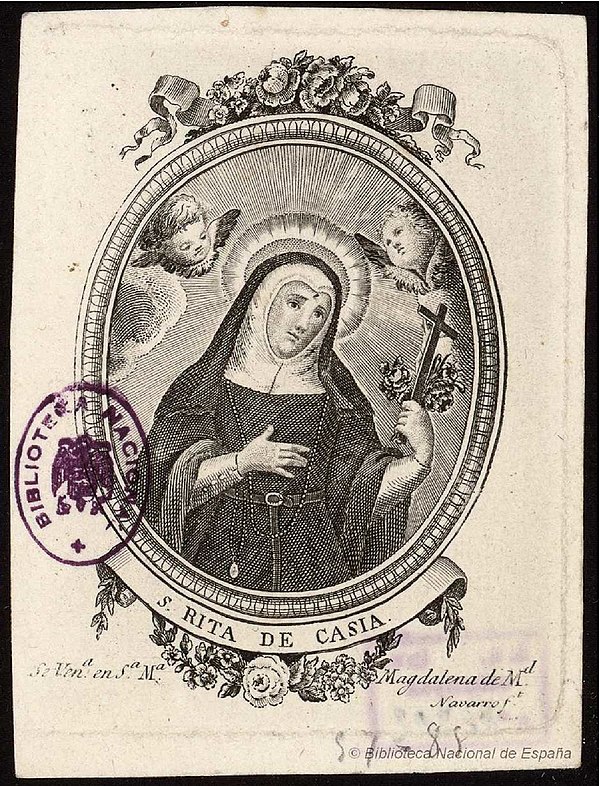
In the end, Saint Rita was allowed to enter the convent in her late thirties. The legend says that she was transported by levitation into the garden of the Monastery at night, but her acceptance into the convent alone is miracle enough for me! 


Stories of Saint Rita's mystical life while in the convent are very engaging. It is wonderful what mystical experiences can be had when leading a contemplative life. When she was about sixty, she was meditating on an image of Christ crucified when a wound suddenly appeared on her forehead and it came to be considered a partial stigmata. Some of the paintings of her depict her with Christ's crown of thorns.


Saint Rita is one of "the incorruptibles," as her body shows no sign of deterioration. It is kept in a glass-enclosed case.


I doubt I'll be buried in a special glass case. I can't even get my parish to mail the weekly bulletin to me. (It is hard for me to read it online, and when I have a hard copy, I feel connected to my community.)  Anyway, they do it for a few weeks, then it stops and I have to call and remind them. Then they do it for a few weeks, and it stops again. And I call them again. Finally, after 4 or 5 go-arounds like this, I have given up.

There are quite a few things about Saint Rita's life that remind me of my own. That is one of the wonderful advantages of having saints to whom one can point one's gaze. She had a thing for roses, evidently, and I have several potted roses in the garden of my apartment. She was also bedridden during the last years of her life, and I am nearly there myself. Once, in January, she asked a visitor to bring her a rose and although it was winter and roses are not expected at that time, the visitor found one beautiful rose in the garden and brought it back to Rita. So she is often depicted with roses.


In the 20 years that I have lived as a hermit in the city, I spent the first ten years trying to get a return phone call from the Bishop's office with regard to becoming a Diocesan Hermit, which is in the gift of the Bishop's discretion. First one bishop and then his replacement, with the same result. No matter how many people I called, I received no response - only broken promises of help. 

The parishes have not been welcoming, with the exception of a handful of parishioners.  In the particular case of the Byzantine Catholic Church, whose liturgy I enjoy much more than the standard Roman Rite, I was actually harassed by the young Ukrainian priest who made loud and bawdy jokes about the size of my posterior, in the company of half a dozen and more parishioners, male and female, complete with pantomimes and rude words.  He laughed at me, as did the other parishioners (mostly the men) who stood around enjoying the protracted joke made at my expense. Joining the Catholic CHURCH has been a universally disappointing experience, with regard to the organization.


There is a part of me that feels embarrassed and humiliated by reporting this story.  This is likely a result of PTSD to which this experience added a level of shame. It makes no sense that I should feel embarrassed by the obnoxious behavior of that callow young priest, but psychology is complicated. I have wrestled with including the story in my writings, but grit my teeth and bear the ignominy. Why should I feel shame for the reprehensible behavior of someone else?

After the first ten years, I realized I would have to live the solitary contemplative life without any corporate support whatsoever.  I am completely on my own EXCEPT, that is, from The Lord and from his messengers, the holy women who assist me and give me great encouragement in The Faith, because while the institution has abandoned me, God sees this and won't allow me to remain unsupported.  He is there for me ALWAYS, and I sometimes wonder if He has graced me with special favor because I have been abandoned by the institution.


There is a wonderful quote in Hosea about the woman who has previously lived a very indulgent life:

"Therefor I am now going to allure her; I will lead her into
the desert and speak tenderly to her."

The Lord goes on to promise that He will return to her the vineyards of her youth, and her lands, and that she will sing as in the days of her youth. Further, He says:

"You will call me 'my husband'; you will no longer call
me 'my master.'"

In response to the world's abandonment of the solitary contemplative, The Lord brings her closer to Himself, in a more intimate encounter with Him.

I used to carry around these quotes on a small piece of paper in my wallet, until I memorized them and completely internalized them. They represent to me the beautiful advantages of solitary contemplative life.


Abandoned by the world and even by the hierarchy of The Church, The Lord rushes in to uplift the person in their solitary life that has been dedicated to God.

There is a similar idea reflected in Psalm 27:10, with regard to someone whose family has thrown them away:

"For my father and my mother have left me; but
the Lord hath taken me up."

This theme is repeated throughout the Bible and gives me tremendous encouragement, as do the stories of the lives of the saint who ALSO are very often abandoned by family, by society, by husbands, and by the institution and hierarchy of The Church. Alone and abandoned, He speaks to us in our heart and if we open our arms to Him He "takes us up" unto Himself and the Heavenly realms.

I clearly see this in the lives of the saints, such as Rita of Cascia, who wanted from a young age to join herself with The Lord and yet everyone tried to get in her way of it. (I also became interested in the Catholic Church when I was 11 and was corresponding with a convent of Carmelite nuns - much to the horror of my mother, who hated religion, and Catholicism in particular.)


Rita's parents, knowing her devotion to God and her desire to join the convent, married her off to a rich man instead, likely hoping to gain some financial advantage thereby. 

NOTHING went her way, yet she persisted in her love of God and her desire for union with Him. It did not matter if the entire world refused to support her in this, she maintained her devotion and lived with The Lord in an intimate state.


Stories like hers help me to hang on and persist in keeping company with The Lord, who is here with me every day, accompanying me in my trials. I am able to talk to Him and ask Him for help and He unfailingly gives me encouragement.

Consequently, I have given up all effort to gain spiritual assistance from the institution of The Church. There is no point. Instead, I rely upon a wealth of spiritual and religious texts and historical documents, as well as the large number of movies and documentaries that are available on the internet.

There are a few very special holy women who assist me with great love and generosity, and I look upon them as messengers of God. Some days, I feel I am in bliss. The problems of life continue and I lament the constant trials, but do not lose my faith. Even on the more rare occasions when it seems that all my life circumstances look like absolute Hell, my faith continues unabated and serene because I have the company of The Lord in it. Always in the background, he speaks to my heart.

It no longer matters if a callow young priest characterizes me in a comical, disrespectful fashion and thereafter lies about it to his adoring fans who provide cover for his behavior. It does not matter if people who promise to help me fail to do so. If telephone calls are not returned, if people gossip and spread untrue rumors, if I'm discounted and disparaged at every turn - none of it matters any more. Nowadays, I can not imagine anything better than my quiet solitary life with The Lord. He has taken me up.


Of course, the Catholic Church in New Mexico has much bigger fish to fry than my pathetic case.  My experiences are NOTHING compared to the abuse that children have suffered at the hands of pedophile priests. The New Mexico Catholic Church is currently paying out millions of dollars for its sins of covering up crimes and giving shelter and protection to criminal perverts. It is no wonder that I have been unable to get support for my contemplative spiritual life. I am careful to remind myself that this rejection does not elevate me or make me special. I am beside the point - an unnecessary and unimportant person, in the scheme of things. 

Unfortunately, there are many people who see the contradictions of the behaviors of some of the humans in our institutions and they abandon the faith because of it, thereby losing "the pearl of great price." They do not understand that the  faith is holy, whereas not all of the people responsible for the management of its dissemination are similarly holy. It makes me sad and I pray for them to see the difference and stay with The Faith.  Let us pray for all these lost souls. 


Saint Rita was well known for miraculous results to her intercessory prayers on behalf of others. She is particularly known for resolutions to "impossible causes," such as the cured blindness of a child while the saint was still alive.

She died of tuberculosis and immediately eleven miracles were attributed to her as the result of the prayers of the faithful who asked for her intercession.


One of the prayers to Saint Rita goes like this:

"O holy Patroness of those in need, St. Rita, whose pleadings before thy 
Divine Lord are almost irresistible, who for thy lavishness in granting 
favors hast been called the Advocate of the Hopeless and even of the 
Impossible; St. Rita, so humble, so pure, so mortified, so patient and 
of such compassionate love for thy Crucified Jesus that thou couldst 
obtain from Him whatsoever thou asketh, on account of which all 
confidently have recourse to thee expecting, if not always relief, at least 
comfort; be propitious to our petition, showing thy power with God on 
behalf of thy supplicant; be lavish to us, as thou hast been in so many 
wonderful cases, for the greater glory of God, for the spreading of thine 
own devotion, and for the consolation of those who trust in thee. We 
promise, if our petition is granted, to glorify thee by making known thy 
favor, to bless and sing thy praises forever. Relying then upon thy merits 
and power before the Sacred Heart of Jesus, we pray thee grant that 
[mention your petition here.]  O pray for us, o holy St. Rita, that we may
be made worthy of the promises of Christ."


Also, I ask today for prayers for my neighbor who has Parkinson's for the last 29 years and is becoming seriously ill in her 69th year of life. I am doing what I can to make phone calls for some help to be given to her, but in the meantime, I appreciate very much the prayers of all of you.

God bless you, and have a wonderful week.

Silver "Rose"