Saint Olga of Kiev, my 34th great grandmother

Saint Olga of Kiev, my 34th great grandmother
SAINT OLGA OF KIEV, MY 34TH GREAT GRANDMOTHER
Showing posts with label contemplative life at home. Show all posts

Sunday, February 19, 2023

FRA ANGELICO AND THE SPIRITUALITY OF ART - FEBRUARY 18


The Dormition of the Virgin
by
Fra Angelico
(born Guido di Pietro, aka Giovanni da Fiesole)
Painter and Dominican Friar

Fra Angelico, one of my favorite painters, was declared the patron saint of Catholic painters in 1984 by Pope John Paul II. He had a lifestyle that may be the envy of most religious painters, as his was a blessed balance between traditional conventual religious life and the spirituality of fine art!

He was called the "Angelic Friar" (which, in Italian, is "Fra Angelico") and of the several names by which he was known, this is the one that "stuck."  He was given this name because his paintings were angelic and depicted calm, illuminated religious subjects, while he himself was exceedingly pious.


The History of Saint Nicholas
by 
Fra Angelico

I have met and read about a number of spiritual personalities who were also deeply spiritual and talented artists. There is something about the enclosed life of contemplation that attracts the heart of the artist with a mystical bent. I was also attracted to it, but came too late to the Catholic faith to be of any use to a convent. Instead, this is exactly the lifestyle I have adopted at home, as a disabled lady, though I can't pretend to come anywhere close to this artist's talent!  Obviously, I am not dead yet, so we will see how I proceed with my novels and my paintings.                                                                              


The Deposition of Christ
by
Fra Angelico


Fra Angelico is obviously very famous and there is quite a lot written about him. His frescoes still contribute to the holy atmosphere of the monastery, and many paintings can be viewed in museums. The largest collection is at the San Marco Museum in Florence, Italy.


Fra Angelico began as an illustrator of missals and religious books sometime around 1418 when he entered a Dominican convent in Fiesole, Italy. After some time, Pope Eugenius IV summoned him to paint some frescoes for the Chapel of the Sacrament at the Vatican that is now, unfortunately, destroyed. Other frescoes were painted at the behest of one Pope or another, usually by his assistants, copying or filling-in his original designs.  

For about three years, he served as the administrative head ("Prior") of the Convent in Fiesole - a job I imagine he would not have enjoyed. Artists are typically uninterested in business and the organization of life. Their souls are usually occupied with The Divine. I don't know why it was such a short time, but perhaps that was the practice at that convent - to keep the duration of office short for the sake of the soul and to keep the person humble. If I can find the time, I will dig into it and learn more about that time period (1449-1452.) (By the way, "convents" are usually insitutions peopled by women in the modern West, and Monasteires are usually for men. Different times and countries used those terms in different fashion.)


Much is written about Fra Agenlico on the internet and elsewhere.  I am willing to bet there are some stunning "coffee table books" of his work, so I won't reinvent the wheel and go into too much more of his life.  I would just like to say a little about the place of the artist and art, in general, with respect to religious life.

In 2012, the DIAKONIA OF BEAUTY was founded to encourage an "exchange between artists and the Church."  It offers education,  prayer, and spiritual and economic support to members. Membership consists of musicians, poets, singers, painters, architects, sculptors, actors and dancers."


"Artistic creation completes, in a certain sense,
the beauty of creation..."
Pope Francis

Divine love is the origin of the artistic gift - that impulse to bring into the world a thing of beauty, in imitation of and perhaps in concert with The Divine, and "authentic art" can "speak eloquently of the beauty and goodness of God." (Pope Francis.)

With Pople John Paul II, Pope Francis said that art must "make perceptible, and as far as possible attractive, the world of the spirit, of the invisible, of God."


The Ascension


I have found a couple articles about the Diakonia, and I offer them, below, for anyone who has interest:


My personal theory is that when a person is born with a natural creative talent, this is not only a gift from God, but a message to the person. That gift is meant to be used for the Glory of God and His people. For me, art is a type of bridge of communication between the soul and the Divine that can be witnessed, appreciated and admired by onlookers.  It is communication in solid form.

As a creative person, I have seen what happens when I try to take as vocation a different path than ART. It does not work very well, Certainly, I was able to take various office jobs to support myself, but I would not say that I was terribly successful in it. It was what I needed to do to support myself, i.e., put a roof over my head and food on the table.  But it did nothing for my soul or anyone else's!

However, it occurs to me now as I write this that God's timing is perfect because, when I was younger, I doubt I had much of anything inspiring to contribute to the world, with either my paintings or my writing. 


The Annunciation


I was born into an anti-religious family of poor moral character, except for my beloved Grandmother who wasn't a saint, but was a very good woman, as far as I was concerned. She was opposed to organized religion, however, and she always used to say that "all you need is the golden rule."  The golden rule is fine, for as much as it speaks about our treatment of others, but it is missing a great deal as the sum total of one's personal philosophy of life. My mother, with whom I lived, absolutely hated Catholics. She eventually became a Jehovah's Witness.

My parents were hostile to religion and I was prohibited from continuing my communication with some Carmelite nuns I had discovered in the town where we were living for a while.  After leaving home during the "hippie era," it took me a long time to "catch up" with the cradle Catholics, having cycled through other religions before taking it up again.  

I have long ago forgiven my parents for the awful childhood they gave me, so there are no worries on that score, but, coming from this family, it was natural that, upon leaving home at age 17, I would start making a lot of mistakes, wandering here and there. I did not know how to "do" life. I did not have a clear picture of what I wanted because, rather than running toward something, I was running away from those people.


Christ Glorified in the Court of Heaven
by
Fra Angelico

My journey to Catholicism took a circuitous route, the details of which are not terribly interesting, except that it is important to note that, by the time I became disabled and had to retire on my small Social Security pension, I had seen a lot of the world, had many experiences, spent a lot of time in prayer and reflection, and was finally prepared to contribute art worthy of its Divine purpose, inspired by and infused with The Holy Spirit. Perfect timing.

There is no guarantee that the result will be a masterpiece. I can only pray for The Lord's assistance and apply myself the best I can.


Art is more than something pretty to look at. In 2018, Pope Francis met with a group of two dozen or so artists from around the world, leaders from the Diakonia of Beauty, and he told them, "the gifts that you have received are, for each of you, a responsibility and a mission." In this meeting, his aim was to ask them to help communicate the beauty of transcendence through their artistic language.

Everyone has a vocation, and those of us who are artists have a role as mediators between heaven and earth. Instead of searching for "vainglory or easy popularity, or the "petty calculus of personal profit," we must be dominated by the Divine consciousness.


Coronation of the Virgin
by
Fra Angelico


I hope that this post inspires you to remain true to your Divine Mission and vocation, whatever that is, in artistic or other realms, because it is through this world that we express our gifts and return them as tribute to our Maker.

God bless us all!

Silver Rose

P.S. I have gone mostly blind in the left eye, with unreliable vision in the right, so if you happen to see a typo here and there, please do not hold it against me, but I WILL appreciate it if you would shoot me a message when you find a typo and tell me about it so I can go in and change it.  I will be SO grateful if you would!  Thanks so much.

Also, please do not forget that I am working very hard to finish my novel, and I need some research materials, mostly consisting of prize-winning books published last year that give me a picture of what is happening with modern literature at the moment. In addition, inflation has hit me hard when it comes to putting groceries in the cupboards, so if you could donate to my Paypal link, above right, I would be most grateful.

Anyway, Amazon has my address and can mail the items direct to me from my wish list. Help me to help myself, won't you, even if it is just a book or two from the list?  Here is the link:


Saturday, January 14, 2023

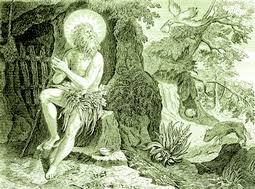
SAINT PAUL OF THEBES, THE FIRST HERMIT - JANUARY 15


Saint Paul receiving bread from the raven
that was purported to keep him alive to
be more than 100 years old


In a couple weeks, I will be celebrating my 20th anniversary as an urban hermit, so the topic is on my mind.

You know, I am always fascinated to read about the lives of these saints who were hermits, and there are quite a few of them in recorded history.

Paul is considered the first Christian hermit. We know about him because Saint Jerome wrote about him and Saint Anthony the Great, who had a connection later in life.  Paul is said to have lived to be more than 113 years old, kept alive by a raven that brought him half a loaf of bread every evening. I don't know what to say about that. I don't think I could be kept alive by only half a loaf of bread every night!


Paul did not initially intend to become a hermit. His brother-in-law wanted to grab his inheritance, so he was about to report Paul to the authorities for being a Christian. Paul went out into the desert to escape being imprisoned and killed but he eventually realized that hermit life suited him.


Obviously, he could not benefit from his inheritance ANYWAY, living in the desert like that, so it appears that he was not that attached to money to begin with, and his brother-in-law needn't have conspired to rob him of it. I find it interesting that I was also robbed of my inheritance and, although I was originally distressed about the injustice of it, considering the level of my needs as a result of my numerous disabilities, I have come to see that it might have turned out to be a curse, if I had not been written out of my father's will after he got Alzheimer's. I would likely have been hounded by people who were intent on grabbing what they could. Money is not the solution some people imagine it to be.  

I DO wish I wasn't a burden on friends, though. That is the one regret. On the flip side, I believe that The Lord has personally sent these kind people to me as his emissaries of love.


The person who robbed the inheritance will have to pay the price instead of me, I suspect. Anyway, the lack of the inheritance provides more opportunity for suffering that I may then offer to the Lord, and I should be grateful for the grace to endure it. I know it sounds backward to some people, but suffering is a type of spiritual currency. It is just ONE of the many ways that God brings all things to the good for those who believe.

Hermits, though they live alone, are normal human beings. They do have friends, but the nature of the relationships are not frequent or typical. Saint Paul became friends with Saint Anthony the Great during two days in Paul's 113th year!


Saint Anthony the Great and Saint
Paul of Thebes, the first hermit

Anthony and Paul only spent a day and a half together, and the next time Anthony went to see him, Paul was dead. There is a charming myth that two lions helped Saint Anthony dig Paul's grave.

I would have loved to have heard the conversation between those two holy men. I can only imagine!


There have been times, when considering my hermit life, that I have thought I should give it up because I am "doing it" imperfectly, but except for the rare moment of loneliness, I still feel that this life suits me, even if I am not a saint thereby. It is good for the ego for a person not to be too "successful," especially a religious person, it seems to me.

So I will slog along in my pathetic representation of a religious hermit, do the best I can, and be grateful for it all. When I celebrate my anniversary on February 3rd, I will be suitably humble before God.


The lives of the hermit saints bear little, if any resemblance to my life, but then the life of the typical resident of Thebes at that time looks nothing like the typical American in 2023! In addition to the differences connected with living a modern life, my numerous and growing disabilities also interfere with the aceticism one would usually expect from a hermit, so I do the best I can. The constant chronic pain is my offering and may be a more painful sacrifice to give than the more austere lives of these early saints. We all do the best we can within the conditions that are provided and the parameters of our own abilities.


Don't get me wrong. I have given it a lot of thought and wondered if I "should" give up the idea of the hermit life, but, although my religious practice is not perfect and, in some superficial ways, I appear to be a fairly typical senior lady of my time and place, I have no strong desire to have any other kind of life goal. I kept trying to see myself doing anything other than what I do now, and I just could not rustle up the interest! If I had wanted a more "normal" life, such as the other women I know, I surely would have tried for it long before my 20 year anniversary, don't you think?


Whatever defects remain in my daily practice must be battled and subdued, if possible, but in any case I will not give up the goal of gaining a more perfect union with The Lord through giving myself to Him alone, even if I fail in the attempt.  Please wish me the best and pray for me.

In the meantime, if you are interested in Saint Paul of Thebes, the First Hermit, and his contemporaries, or you are curious about early hermit life and lore, please take a look at the following links:


At some point, I believe that, such as with Anthony and Paul,  I would also like to develop a friendship with at lease one other hermit - especially an urban hermit. We have much to share with one another, I think - especially after 20 years of doing this. I also wonder if it would be a good idea to find a regular confessor, especially now that Covid is not as much of a problem as it was - but I suspect that I may wait another year before risking spending too much time outside the hermitage. God will bring what He wants for me.

I hope you will all pray for me, as I pray for you.

God bless and keep you!

Silver Rose


Sunday, April 26, 2015

THE IMPORTANCE OF THE DOMESTIC CHURCH

The statue of our Blessed Mother Mary that looks down upon me
when I am seated in my customary chair in the living room


For the last two weeks or so, I have been ill with a stomach bug, and I have spent more time in my recliner chair.  Being disabled, I spend quite a bit of time in it anyway, but I sort of poured myself into it a couple weeks ago when I first came down with the stomach flu and haven't budged much ever since.  In fact, one night I slept the whole night here.  On many other nights, I spent at least 3 hours sleeping in it.

When I awake from one of these naps, or when I look up from my crochet project, my computer, or my reading, my living room shrine, with its candles and icons and statue, are immediately in my line of sight and invites my contemplation.


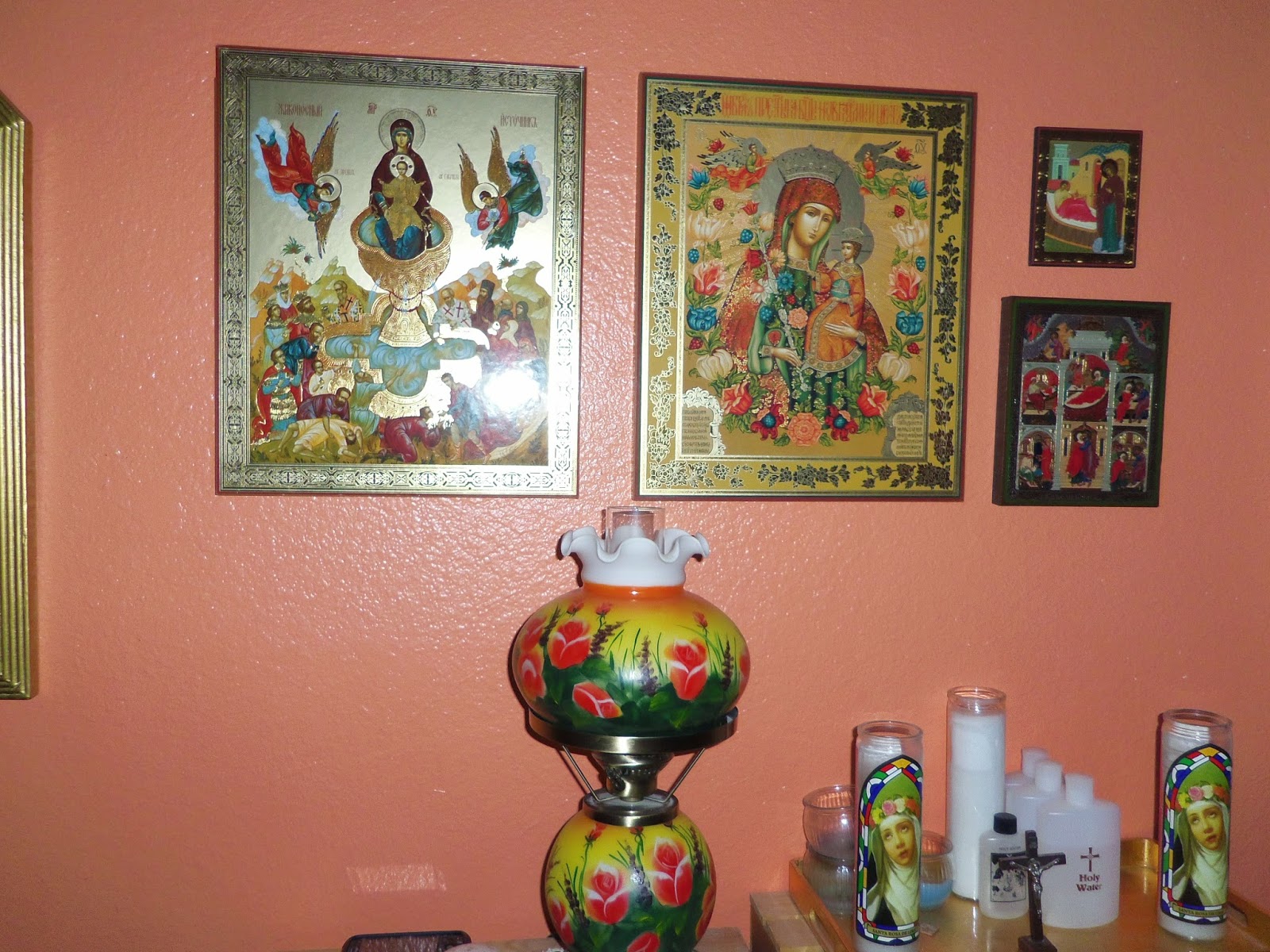
The prayer corner in my living room


Drawing inspiration and encouragement from Jesus, Mary and the Saints, I often respond with a short prayer before I move on to my next task.  Having the Lord always in my line of sight is a reminder that He is always with me.  My guardian angel is always with me.  The saints are available to me and are ready to intercede for me.  I am not alone.

Speaking as a woman who has lived "alone" for more than a dozen years, it means a lot to be able to say that I am not actually alone, and this is part of what my Catholic faith has done for me.  The awareness that I am part of the body of Christ and that there is an awesome host of beings accompanying me through life is both stunning and soothing at the same time.  I have only to remind myself of this by gazing at the numerous signs placed around my apartment hermitage.


My living room prayer corner


Despite my numerous discomforts, I feel a welling up of joyful gratitude for everything the Lord has given and has promised me and every other Christian who follows Him.  Contemplating the icons, crosses and crucifixes throughout the house gives me fresh incentive every day to praise Him and glorify Him in all my thoughts, words and deeds.  As my eye falls upon the picture of Him, I tune into the feeling of His presence within me.  When I am washing dishes or cleaning the bathroom, I am doing it for Him.  I feel that, having mentally consecrated this house to him and his worship, everything I do, I do for Him.


Little picture of Jesus on the bedside table


On those mornings when I wake in my bed instead of my recliner, I am likewise greeted by a host of icons, and I am moved to say, "Glory to Jesus Christ!"


Part of my bedroom prayer corner


Just as in the living room, my eyes rest upon Jesus, Our Blessed Mother, saints and angels, wherever I look in this room.


The other wall of the prayer corner


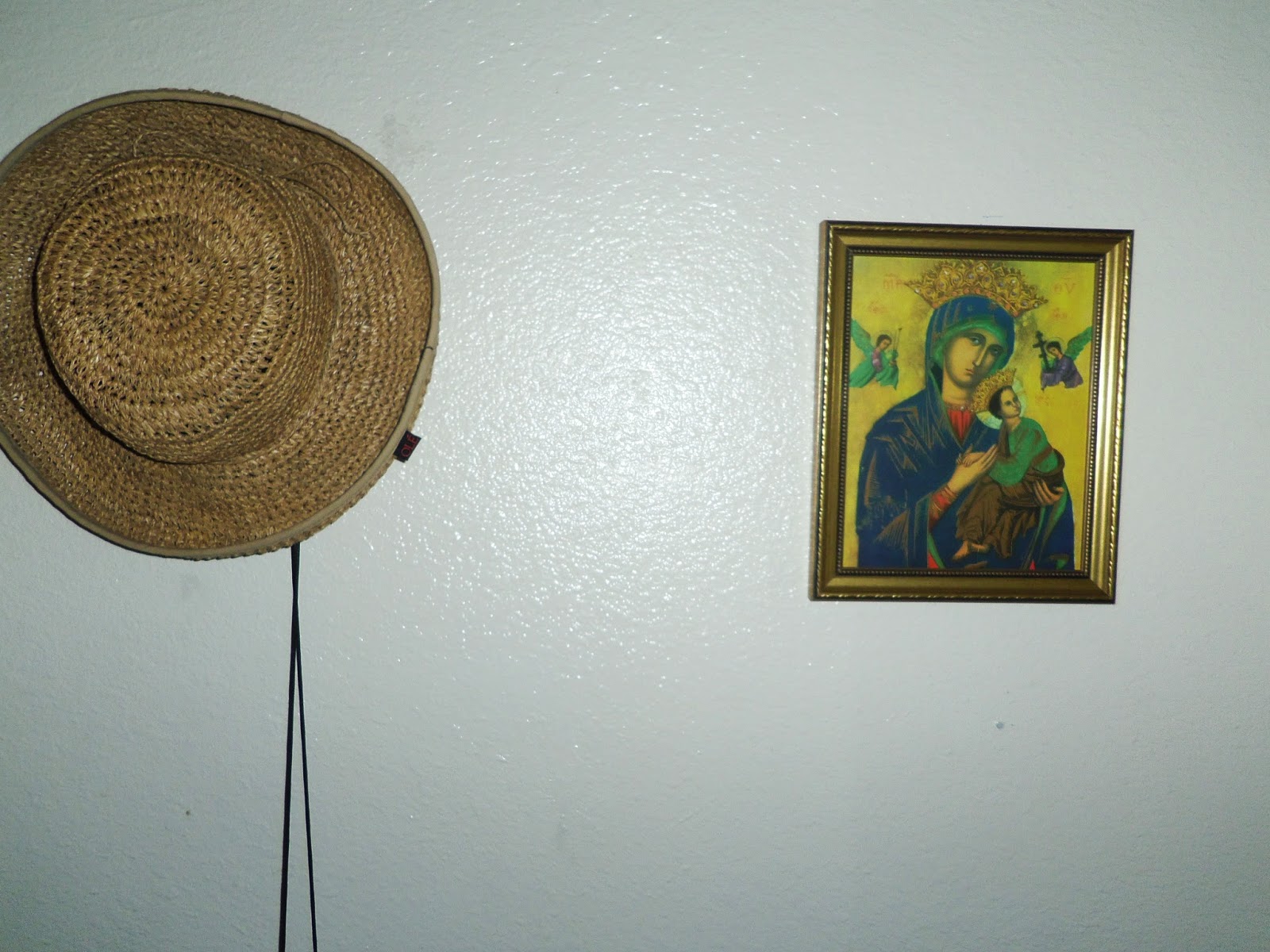
Images of the Blessed Mother on another
bedroom wall


In addition, I keep Holy Water available in two fonts; one at the front door and one in my bedroom.  I used to have a third, but I gave it to a visiting Catholic who didn't have one at home and whom I thought would like it for himself and his family.

Holy Water font in the living room by
the front door


Holy Water font in the bedroom

I try to encourage people in their efforts to spiritualize the atmosphere of their homes because it is especially important to remember that, although our churches are treasured places where Jesus comes to us in a special way through the mass and through his body and blood in the Eucharist, we must carry our faith and the awareness of His presence with us throughout our lives.  Visual cues help us to do this.  They also help us to bear witness to our faith.

Whereas our secular culture is now trying to limit our religious freedom to a mere freedom of worship, which quarantines our faith within the 4 walls of our churches, we need to break out of that prison in which the culture is trying to retain us and bring our faith into the world in a visible way. We know that faith without works is dead and that all the visible signs of faith are pointless without following Christ in every thought, word and deed, but I am suggesting that, while the habit of a nun, monk or priest is a powerful visible signal, our homes can also be a silent witness to every neighbor, relative and friend who visits us while at the same time giving us strength and continual reminders of our companions who travel with us, mostly unseen.


Angels in the bedroom


What I value is not in the slightest bit in question, once someone comes to my home.  I am not advocating that everyone adopt my style of decor, however.  It would be too colorful and busy for many people.  I only suggest that evidence of one's faith be prominently displayed, for all the reasons previously mentioned, and that there be at least one corner devoted to prayer.


Icon of our blessed Mother
at the back door


It goes without saying that, having constant reminders of God scattered about one's house is a good incentive to prayer and contemplation.  Personally, I like to make liberal use of candles and genuine church incense, in honor of the Divine Person to whom I pray.  The fragrance tends to persist for some time after my prayers are finished, reminding me of the constant presence of the Lord.


Give some thought as to whether your home speaks to you and to others about your faith and your values.  Did you decorate with God in mind, or do you take your cues entirely from some style of design one might find in a secular magazine such as Better Homes & Gardens?


My front door


The wall of my foyer


I would be interested in seeing pictures of your home and prayer corners from any of you that care to send one.

In the meantime, I pray for you, as I hope you pray for me.

God bless us all,

Silver Rose Parnell
(c) 2015


Sunday, September 21, 2014

THE CONTEMPLATIVE, MANUAL LABOR, AND PRAYER PROJECTS

Baby blankets and hats being prepared for donation
to the Gabriel Project at Project Defending Life
in Albuquerque, New Mexico


I just wanted to dash off a quick note for my other contemplative sisters and brothers with regard to the type of work one decides to do in the way of ministry or of making an income.

It is best to stick with what I call "manual labor," which doesn't have to mean you are out digging ditches.  As long as it is something that engages the body in rather routine tasks that do not involve much executive function of the brain, that will be suitable.

In the contemplative monasteries, they make candy and altar breads.  Some of them produce finely embroidered vestments.  I know one monastery that produces some awesome pumpkin bread.  Others make cheese and some even make wine.  Many grow a good deal of their own food.  We can take our example from the contemplative monasteries and convents and imitate their long-standing devotion to a simple life in which the hands are used for labor.

Something that occurs to me as being rather important is that most of these activities can be done in peace and silence.  I don't believe that a stock trader or a retail sales clerk would have an easy time of it, as far as developing a contemplative life.  Their jobs would pull them too far in another direction. Anyway, I am mostly speaking to the home-bound in my blog....the disabled and elderly who have the time and the quiet home life on which to capitalize.

Baby blankets and hats are one of my ministries.  The work is mostly repetitive, and with each stitch I can say a prayer for the welfare of the new baby being welcomed into the world.  Sometimes I listen to the rosary on EWTN and recite it along with Mother Angelica and her nuns.  Sometimes I wing it. I also paint, but I am having trouble getting back to that endeavor.

Anyway, if you choose a physical task like this, it is far easier to "pray unceasingly" than if you choose a more active ministry that requires interaction with other people or a lot of writing, research, typing, and that sort of thing.  The more involved you become with outside activities, the less you will be operating as a contemplative.  If you have a tendency toward loneliness and must be with people to feel alright, then the contemplative life is not for you.  We are communing with God at every opportunity we can snatch out of the jaws of time.

I don't mean to say that everyone should be a hermit. I do think we have to limit our interactions with the outside world and keep them within certain boundaries.  Each of you will have to decide what those are for yourself.

It is important to focus your prayer life also for, in addition to quietly spending time with the Lord in the practice of the presence of God and in strictly contemplative prayer, we are called to pray for the suffering world in many areas.  With so much going on in the world today, it is hard to know what to pray for.  It could be overwhelming.  I recommend having one primary prayer project that is a constant.  For me, it is the prayer that the Catholic and Orthodox Churches will resolve their longstanding rift and become one with each other again.  My prayer life is dedicated to that rather large request.  Not only does this give me a focus, but it gives me a PURPOSE as well.  This is important.

People will ask you to pray for them, and there will be transitory requests with which you can pepper the stew, so to speak.  Don't lose sight of your mission, however.  It will help you to stay more easily on the path.

I would be interested in hearing how you construct your contemplative life.  Feel free to comment and let me know.  Perhaps others will be interested also.

God bless you,

Silver Rose Parnell