Saint Olga of Kiev, my 34th great grandmother

Saint Olga of Kiev, my 34th great grandmother
SAINT OLGA OF KIEV, MY 34TH GREAT GRANDMOTHER

Friday, January 31, 2025

Saint Ulphia (Wulfia or Wulfe) - January 31


Saint Ulphia
(died January 30, 776)
Icon available on
UNCUT MOUNTAIN SUPPLY
Click HERE to purchase

I started writing this post in January but was dealing with the aftermath of a terrible fall that hurt both knees badly and caused me to slow my movements even more than what is typical, so it became lost for some time and I am just now getting back to it on February 6th. I will try to post it in the proper order online, but if I am unable to do that, I know you will understand.

There are a surprising number of female hermits who have been sainted. Typically, when the subject of "hermits" comes up, most folks tend to picture a grizzled old man, usually with long, unkempt hair and a beard to match. For some reason, the men get a lot of celebration while the women see very little mention. Perhaps women are more successful in remaining hidden.

I enjoy reading about these female hermits, searching for clues as to how they survived this mode of life and hoping to get some picture of their inspirations and motivations. I wish there was more information on-line. This is yet another one of my many projects for which there is not enough time. The balance between the religious, intellectual, and writing projects is delicate. There is only so much time in each day, and I am becoming less and less able to do much of anything physical, while at the same time I have, essentially, no help with any of the physical jobs that need doing in order to function properly.

Saint Ulphia
with her mentor, Saint Domitius
Amiens, France


Today's little-known female hermitess lived near Amiens, France, in the 8th Century. She was a disciple of Saint Domitius, located at the Abbey of Saint-Acheul, in Amiens. Perhaps her relationship with that (male) saint is how she became known by others and how a community of disciples began building hermitages around her. She organized them into a community and then went back into seclusion.

It is that particular sequence of events, when she got involved with organizing others, that initially interested me, particularly because I am currently peeking outside my own hermitage in a temporary effort to offer some inspiration for a type of ministry that I feel the Church is lacking, as a whole. (This is the "Parish Membership Ministry" that I've designed with various modules, including the "Elder Orphans" ministry. It is taking forever to even see if it will be enacted because it is proceeding in that glacially slow way that appears to be so typical of the churches that are struggling to keep their membership. They are so stuck in their procedures that I believe they have trouble letting go of those things that are bogging them down to begin with. The infections of modernism and secularism are at the heart of most of it. More about that in another post.)


I have encountered many unexpected surprises in my brief foray into a recently increased contact with other humans.  Other people, not realizing that I am living a different kind of life than they might imagine, are not equipped to understand our differences.

In the Middle Ages, I have the impression that most people were aware of the vocation of hermit and anchoress.

I have considered wearing a modified uniform, a "habit" that communicates some kind of religious lifestyle but which is different enough from the standard habit that I won't look as if I am impersonating a nun or sister of any particular order. The key point is modesty, of course, and a simple style. My style has leaned toward maxi dresses since I was 15 and I used to sew them up by hand from the lightweight cotton Indian 'bedspreads" that were popular during the hippy era. I have a bolt of nice, plain linen I bought online and will likely end up sewing some new ones with long sleeves, and leave it at that. Somehow I have to get the back room organized in order to produce anything with that sewing machine. When the time is right, The Lord will provide the needed help.


Up until now, I have liked keeping a low profile and not catching the attention of those around me. However, I am beginning to think that it may be time to have more of an outward presentation and to start wearing a habit of some sort. It would certainly reduce the number of pieces of clothing that I keep in the hermitage and would, among other advantages, reduce the amount of laundry duties. It would also explain to some people, without my having to say anything that could be interpreted as rejection of others, that I am not typically involved in the normal entertainments of secular life.

Saint Ulphia sounds like a real character. Supposedly, she was living on the banks of the Noye River, determined never to marry, and when potential suitors came to bother her, she would behave as if she was crazy, just to scare them off. The Bishop gave her "the veil" when she was 25, I suppose granting her similar vows to that which the Diocesan hermits take in these modern days.

She was the attendant of the famous hermit Domitius, who was a Deacon who gave up active work for the life of a hermit. He was much older than she was. She attended to him, and he endowed her with his wisdom. It is not unusual for hermits to attract devotees who learn from them the wisdom of the vocation. It reminds me of my experiences as a Hindu nun, under the tutelage of Swami Swahananda at the Vedanta Society in Southern California.


I do not have a teacher for the last 20 years, but having experienced the support of a highly spiritual elder in my former religion, I feel that I have at least the confidence to try to be a decent Catholic hermit.

There has yet to be a reputable Catholic guide and exemplar for me, ready at hand, and I am sure The Lord would provide one if He felt this was necessary. He knows how reliant I am upon the writings of the experts and I will not get waylaid by quacks or charlatans who try to bamboozle the unsuspecting devotee through thaumaturgic "cosmic poo poo." He knows that I stay grounded.

Speaking of which, I have received no return phone call from the Archbishop since I reached out in December. I was told in December that he would get back to me around January 13, as he was busy until then. I have followed up with phone messages and another email, and I hear crickets.

I cannot pretend to know the reason(s) why "ghosting" people has become a thing that everyone seems to do when they have no use for you.

But I am aware that I am unimportant and also have no money - so why should anyone respond? I am of no use to them and therefore everything that comes across an Archbishop's desk is automatically more pressing than my needs. Besides which, a Dioscecan hermit's vows are given directly into the hands of a bishop, and it may sound like extra work to a man already weighed down with many weighty matters.

On the other hand, I have already lived this life for 20 years, and the only thing I lack is spiritual support and the ability to retain the Blessed Sacrament on my own personal shrine. I will continue to live this life, God willing, for as long as I remain on earth, and I trust completely that The Lord will give me everything I really need.

I am currently not regularly receiving the eucharist, however, and I do need to rectify that situation. The lady that was bringing it to me was subjecting me to a terrible angry temperament, and yelling at me quite a bit - both here and in her car during errands - also yelling at the other drivers in an unending litany of surreal conversation with people who I doubt could hear her with her windows rolled up. Once she even got out of the car, in the middle of traffic, and walked to the car BEHIND us so that she could yell at the driver. It was a frightening series of events.

I finally could not endure it any longer and I believe it is safer not to have her come here because I am beginning to think that she may be suffering the onset of some kind of dementia, alzheimer's disease or something like it, and there are certain instances when those experiencing this illness have completely lost their tempers and gotten violent. I am not able to run away from her, if she should really come unglued, so I told her not to come here any more.

The deacon did not believe me, I don't think. Or he did not want to. I am not sure what is going on there, but he indicated he would not be making any effort to get me someone else. He muttered something about not having volunteers and how rare they are since Covid. Even after Covid has mostly gone away, people have not returned to volunteering, which I find sad.

I also wonder why no one at the parish makes any effort to reach out for volunteers and perhaps announce them after mass. So many Christians are in need of companionship with other friends of Jesus! My "Parish Membership Ministry" is designed to help with this issue, but I despair of it ever getting off the ground. Ever since the internet became enmeshed in our lives, it feels as if humans are no longer interested in interacting with other humans at all.

If I can find someone to drive me, or somehow get a car, it may be better to go to church instead of having someone come here, even if the pain of this exercise is extraordinary. The arthritis I inherited from my mother's side of the family is fairly awful, but I look upon it as an ascetic practice, so even if there is a lot of extra pain, I think I will accept if someone offers to take me, and I will work hard to try to get SOME kind of vehicle, since getting transportation is an awful ordeal at present.


Something tells me that it is beneficial to the spiritual constitution to be treated with disdain. Jesus was treated with actual contempt, scorn and ridicule, yet he managed to maintain his modesty and gentle demeanor throughout his entire ordeal here on earth. I must do the same, to the extent I am able. I am really working on my patience, at present. Being in constant pain for 20 years has added to the difficulty.

Despite it all, I continue to live my hermit life, praying unceasingly, with my mind on Him throughout the day, relying upon the many examples of hermits through the ages in order to form my holy vocation.

I pray for you, as I hope you pray for me.

May God bless us all.

Silver Rose


Wednesday, January 22, 2025

GOD'S DIVINE PURPOSE FOR TRUMP


Circumcise your hearts, therefore, and be no longer stiff-necked.
For the LORD, your God, is the God of gods,
the LORD of lords, the great God, mighty and awesome,
who has no favorites, accepts no bribes;
who executes justice for the orphan and the widow,
and befriends the alien, feeding and clothing him.
So you too must befriend the alien,
for you were once aliens yourselves in the land of Egypt. 
DT 10


Typically, I am NOT political. But because my Christian brothers and sisters have elevated Trump to an almost prophetic position and are WIDELY advertising how they believe that God has placed him into office for some Divine purpose, I HAVE to point out a possible purpose that these Christians have not considered. 
 
First of all, what they do not appear to realize is that this so-called "divine purpose" may be to punish American Christians for drifting so far into arrogance and selfishness that The Lord is going to show us just how damaging our haughty, entitled selfishness turns out to be.

There is more than one way to "take down" a people and force them to recognize their sins and thereby adopt a more humble stance at the feet of our God.

Our entire American history is one of taking advantage of the labor of enslaved people. The resulting wealth and comforts would not have been possible, had not our country started out by just TAKING a huge swath of land from the people that had lived here for thousands of years and importing enslaved people from Africa into it, who were then forced to work. 

The forced work of enslaved human beings was monetized for the benefit of white people, leaving the Africans that we violently forced into slavery to live barely sustainable lives of abject poverty - a poverty, by the way, that has mostly been perpetuated by racism, down through the centuries.

That soul-killing and unfair poverty is mostly responsible for most of the crimes committed by the poverty-stricken peoples, but that is an entirely different topic. But I do have to point out that it has been proven that undocumented immigrants commit crimes at far less of a percentage than Americans, which makes sense. They don't want to be caught doing crimes, because they don't want to be sent back to whatever situation they have escaped in their home country.

Now, hundreds of years after TAKING this land from its previous occupants, we have all this animosity against poor brown immigrants who have LIKEWISE been wage slaves, earning very low income in our factories, watching our children, cooking and cleaning in our favorite restaurants, and laboring in various other, rather hidden, places.

Animosity against these modern slaves is being fomented to the point where Trump has vowed to immediately deport all undocumented immigrants, with total disregard for the giant hole that will be left behind.

One thing that these Christian nationalists do not realize is that these modern slaves are paying more than 96 BILLION dollars a year into American programs and taxes from which they cannot typically obtain benefits, such as Social Security and Medicare. 

What happens when they are kicked out of the country and all that lovely money goes away?

The second question Christian Trump supporters should ask themselves is whether or not they will be encouraging their sons and daughters to go to work at the meat processing plants or in the fields, cultivating vegetables. Who, exactly, is going to do these jobs?

Some Christians THINK they are elevating and recognizing a prophet, when it is entirely possible that they are actually enabling the instrument of their own doom - because THAT guy is going to put us all into a type of abject poverty that is tantamount to slavery where only the top 1%, the oligarchs, will hold all wealth.

The party's over, folks.

Just wait and see.

I pray for all of us, including immigrants.

Silver Rose

Sunday, January 5, 2025

OFFERING THE PAIN OF DISEASE AS AN ASCETIC PRACTICE


Part of a Christian's spiritual program has, for centuries, usually included the imposition of some sort of painful, uncomfortable or inconvenient practice that imitates the suffering of Christ and thereby draws us closer to Him. Christ's pains were taken on purposely, willfully, in reparation for the sins of the world. He certainly did not merit the terrible punishments he received. He offered them to the Father in order to atone for our sorry selves.

Also, to the Catholic mind, humans are body and mind BOTH. We are not spirits who occupy a body for a time and then dispose of it when we die. IN FACT, we are promised that we will rise in our glorified bodies at the second coming of Christ. Our bodies are not awful things. We were all made in the likeness and image of our beautiful Lord but, due to the fall of mankind, the body's demands have become disordered and require tempering and balance.

Thus, part of the purpose of penitential practices is to gain control over the selfish and pleasure-loving body and ego and keep it in proper balance with our spiritual selves. Ascetic practices require and build the discipline necessary to the task. In fact, the instrument with which one whips oneself with cords, made from leather or rope, that is still used in some monastic communities, is itself called "the discipline."  Also a "scourge." 


John the Baptist wearing a garment of camel hair.


In the Middle Ages, pious people might wear a hair shirt under their clothes so that all the day long their skin would be pricked and irritated by it. Some of the saints recommend praying for hours with arms outstretched, in imitation of that agonizing position that Christ was made to take while nailed to the cross.


If one does not know the purpose of these practices and instruments of penance, it can seem odd to the modern mind, but I am not prepared to launch into a detailed explanation of the need for ascetic practice because I am usually writing for a community of people who are generally aware of the basics of Catholicism and monastic life. If you have stumbled across my blog, however, and you are not familiar, I will be happy to refer you to some excellent articles that explain these things. Just send me a comment here or find me on Facebook and I will be happy to speak with you. It need not be a public conversation, as I do not publish the comments I receive.

All sorts of things are considered penitential. Giving alms to the poor, for instance, is considered a penitential practice. Any time we give of ourselves, it involves some sacrifice on our part, and it can be considered to be a penance, especially if done intentionally.


20 years ago, when I became so disabled that I was no longer physically able to work outside the home, I decided to live as an independent monastic, in the tradition of a hermit, since my circumstances forced me into a semi-solitary state. My hermitage has to be located in a fairly urban area because my disabilities require medical supervision and care. The situation of an "urban hermit" is not the traditional setup, obviously, but the location of my apartment is somewhat rural, and it works for me.

Being physically disabled is not considered to be an ideal state in which to embark upon monastic life. It is a difficult life that requires a lot of discipline and a degree of penance, depending on the order one joins. I would never be accepted into a monastic institution in my current state or age of life, as I would be an increasingly inconvenient member of the community. 


In fact, 40 years ago, before I converted to Christianity, I was already beginning to experience some physical problems when I was a nun in a Hindu convent. Even then, I found it extremely difficult to carry out the many daily hours of physical labor that were required. I was often on the cooking schedule, for instance, making the one daily meal for the community of 12, with little or no help, and I remember having to endure quite a lot of physical pain because of all the standing. In fact, it injured me, and I spent a few weeks in a wheel chair, simply from the stress of it, as the disabilities from which I currently suffer were making themselves known at that time. This was inconvenient to the community and caused some of the women to become irate. It was a distressing situation that most monastic institutions are careful to avoid, when they can. 


Me, on the left, when I was in the Hindu Convent,
sitting with friends and the swami


If I had not left to get baptized and convert to Catholicism, I do not know how long they would have allowed me to stay, considering my poor physical condition. My intellectual and spiritual gifts were not in high demand. Half of the nuns were already seniors who were occupying the few jobs that were primarily of an intellectual nature. Their need was for young, physically able people who could keep us fed and the house clean and everything in good working order. This is not an unusual state of affairs for a monastic institution of any religion.


The nuns, eating our main meal of the day
(with the swami visiting)


We meditated a minimum of 3 hours per day, which was a delight, but the newer nuns were also required to do all the menial labor jobs, such as house cleaning, cooking, and that sort of thing. We also performed the daily worship services, which involved some gardening, hiking, and flower preparation. These positions were avoided by the senior members, but I enjoyed the quiet physicality, even if it did hurt my body.

I have always been a voracious reader, and while I was in that convent, I read all the books that were sold in the book store and our catalog by mail. The books by and about the  Catholic mystics and contemplatives, such as St. Teresa of Avilla and St. John of the Cross, Jane de Chantal and St. Francis de Sales tugged at my heart strings.


Saint Jane de Chantal


I read the Desert "fathers" and "mothers," as well as the modern writers, such as Thomas Merton. I couldn't get enough of the mystics! I realized that Catholicism had struck my heart in a way that Vedanta never could. So I left the convent, became Christian, and went back to work in a secular job as a legal secretary. But I always missed monastic life.

Therefore, when I had to retire early, it quickly occurred to me that I could replicate convent life for myself in my little urban apartment and live as an urban hermit, dedicated to God, and live a contemplative life, similar to what I had experienced in the Hindu convent, the schedule and setup of which had been modeled on Catholic contemplative orders. I missed monastic life very much and was thrilled at the idea that I might return to it, in my own fashion.

Saint Anthony the Great - Hermit


My inability to do physical labor would not inconvenience anyone but myself. Keeping a monastic schedule would prove to be difficult, of course. The older I became, the worse the illnesses grew. My Rule of Life had to adhere to the spiritual principles and aims of a monastic hermit life while at the same time accommodating my increasingly inconvenient physical condition. It took some time to come to grips with my limitations and to accept the fact that, like Brother Lawrence, who practiced the presence of God, I am not one of those "high class" monastics whose practice appears to be perfectly regulated to the typical standard.


With regard to my prayer schedule, I adjusted that to accommodate the fact that simply caring for oneself, without help, takes a terribly long time. My solution for that was to be flexible about the timing of my formal prayers and to "pray without ceasing" at all times of the day, through various methods. (I have dealt with this in my blog post about MY RULE OF LIFE, which you may find HERE)

The Jesus Prayer is dear to my heart, and I pray it throughout the day:

"Lord, 
Jesus Christ,
Son of God,
Have mercy upon me,
a poor sinner."


In the early stages of organizing my hermitage, I realized that, rather than having to artificially create pain or inconvenience to fulfill the penitential aspect of the life, I could simply make use of the terrible chronic pain and disfunction which I suffer naturally. I offer it to God in reparation for my own sins and the sins of the world. 

Since I live in an urban setting, albeit close to a rural area and the Rio Grande River, I do have neighbors and, although I do not seek them out for entertainment, I work hard to be helpful to them, when needed. These are small offerings, but they are intentional. 


In these ways, I have transformed, in my mind, what could be considered a personal disaster into a blessed life for which I am grateful. I am a living offering to the Lord, even though my living space has few of the accoutrements enjoyed by monastics living in traditional monastic quarters.

In the beginning of my hermit life, I was more physically able, and I regularly attended mass, but I am not longer able to do that, so I stream the Mass from various providers on the internet. I have no real spiritual support from my parish. I was finally able to get someone to bring me the eucharist at home, but it took a couple years of calling them and begging for it. 

UPDATE (5/26/25): Receiving the Eucharist at home did not last long. A few months into reception of the Eucharist, the woman who brought the Eucharist turned out to be suffering from something which caused her to experience bouts of terrifyingly violent explosions of anger. While driving back from an errand one day, with me in the car with her, instead of talking to me, she screamed and yelled and "talked to" other drivers on the road. She was irate at the way everyone else was driving. 

Suddenly, she stopped the car - in the middle of the street, with me in it - so that she could walk to the car behind us, stand outside it and yell at the driver of that vehicle! It was nerve-wracking for me, especially since I am particularly sensitive to unrestrained or savage scenes.

At my home, she set in on me with that same anger. I was sitting in my recliner, and she loomed above me - standing over me and yelling at me. I was afraid she was going to hit me or do something else violent. I did not allow her to return after that.

When I told the Deacon manager of homebound ministry what had happened, he told me he did not believe me because he knew she would never do something like that and that he would not be sending anyone else. His manner was cold and unfeeling. 

Telling me that I am a liar does not seem like a wise or Christian thing to do. It demonstrated to me that he is yet another person who is faking his religious sentiments. There is a lot of that sort of thing in America at this time. For some people, religion is a social construct and/or a manner in which some people find a position of power or prestige. Others find social connections by which they telegraph legitimacy and respectability. The love of Christ is absent.

The hard-bitten and cruel attitudes of Donald Trump and his minions are reflected in the attitudes and behavior of these people. If you are poor with no family and have nothing to bring to the parish, or if you are not a devotee of Trump, you are shunned.

But the more I am mistreated by these people, the kinder The Lord is to me. The vast lacuna of Christian friendship that the parish leaves behind is filled to overflowing with God, the Blessed Mother, the angels and the saints. I am especially blessed with many sainted ancestors in my family tree, such as Saint Margaret of Scotland and Saint Olga of Kiev "Equal to the Apostles."

Not all parishes are cold and hostile places - but enough are there to present a challenge when trying to make a connection with The Church when one is disabled and homebound.

"Anger is a kind of temporary madness"
~ St. Basil the Great ~

Some Catholic parishes shun and mistreat the poor and needy, disabled and senior who reach out to them, while at the same time they express wonder at why their membership is dwindling.


At any rate, you cannot live this life and be emotionally needy. As a modern-day hermit, one has to be confident in one's connection with The Lord and His love for you because the parish will not likely reach out to you unless you were well known to them prior to becoming disabled and/or you have a lot of family that belongs to the parish. Every community has its own personality, of course. I am just saying that lack of spiritual support from your church family may be one of those painful things you will have to offer up, if you embark on this life, and, even if you have no interest in becoming a hermit, disability and isolation may force you into that position, so you might as well find a way to enjoy it and embrace the vocation that has been thrust on you. God brings all things to the good for those who believe.


Saint Melania the Elder
as a Hermit


Another challenging situation to offer up is that growing disabilities make it more and more difficult to make one's hermitage look like a place of prayer. I have no help at home, even though approved for 28 hours of housekeeping services a week by Medicaid because there are simply not enough people available to do this kind of work. Every once in a while, someone is offered by the agency, but I have had to eventually reject these people, as most of them have had domestic problems that interfere or they were drug addicts, alcoholics, or generally unreliable.

I am learning to accept things as they are and to be grateful for everything, even though there are dishes piled up in the sink. Art projects and rosary makings, meant to supplement the income, present a colorful, happy mess on the art table. The mail has piled up because I am now blind in one eye, and it takes a long time to slog through it. The floor needs sweeping. But, in my mind and heart, I am in Heaven with God, our Blessed Mother, and all the saints and angels.  I am surrounded by the entire Heavenly Court, singing the Lord's praises and enjoying the consolations that being near The Lord bestows.

I predict that we are going to have a growing number of senior Catholics turning to this kind of life, as they grow older. Baby boomers are retiring at the rate of about 10,000 people PER DAY, many of them in fragile or ill health, and it has occurred to me that all of those who are Catholic could do the same as what I am doing. There are SO MANY resources in the forms of books and videos, YouTube talks, and  streaming mass that the guidance is available, even if you do not have a single human person leading you down this path. The ascetic practices become a natural outgrowth of one's normal life as a senior person.

Living as a hermitess is also considered to be, in itself, a penitential type of life. Many baby boomers find themselves alone at the end of their lives. Perhaps this vocation is meant to be.


Saint Marina
as a Hermit


Whether you construct your life as an "urban hermit" or a wife and mother, or a single working person, the method of adopting the intentional offering of life's sufferings as a spiritual practice can be used by anyone. You don't need a hair shirt or a scourge. Offer up all of the naturally occurring sufferings! In this way, all of it becomes spiritual currency. 

The emptiness of your life will be filled by Christ, His Blessed Mother, the angels and the saints, as it is mine.

God bless us all. 

Silver Rose

Friday, December 27, 2024

SAINT NICARETE - DECEMBER 27 - ANOTHER UNKNOWN SAINT


I have always been interested in the unknown saints; those who quietly, without fanfare or any sort of self-advertisement, have followed the will of our Lord and showed their love for Him by doing what he has commanded us.

I call her an "unknown saint" because Saint Nicarete is one of those saints about whom we know little, but whose feast day appears on our calendar once every year. She did not leave any writings, there are no stories about her except the bare bones facts of her existence. 

She was born in a fairly well-to-do family of Nicodemia then a part of Bithniya, which is now Turkey. Well known for her piety, she had originally traveled to the capital in order to take care of the poor with her medical skills. 

I don't know when she shifted her focus to taking care of Chrysostom and supporting and following him, but it is easy to imagine that she became aware of his great saintliness sometime around the period during which she was attending to his medical needs.

Later, she followed him into his exile from the Imperial capital of Constantinople, at which time she suffered greatly along with his other followers.

I appreciate this saint's self-effacing example. 

To humbly obey the will of the Lord, without inserting my own wishes into the mix, without believing in my own inclinations, but having faith in His alone, pertains to those spiritual disciplines that affect more of the surface aspects of my life.

There are various stages in the life of a contemplative living in the world, and this sort of life is, in some crucial ways, more difficult than that lived in an institutionally supported hermitage, convent or monastery. 

My overall spiritual discipline is to "pray without ceasing." There are many different types and levels of prayer involved in being able to do that, ranging from the deep silence of contemplative prayer that harkens back to Christ's instruction that we are to go into our closet and pray in secret to our Lord, to the active, physical prayers in which I am following the Commandments given by Christ of how I am to function in relation to other humans.


In the deepest stage of contemplation, the household is shut down, phone ringer "off" and sign on the door. I keep my attention on The Lord in order to just be with Him. 

Quietly sitting with God, his saints and angels, is a deep form of prayer in which no discursive thought is necessary. It would get in the way. 

Slightly above that type would be the sort of prayer that involves the verbal prayers with which we are all familiar. Some of the prayers praise God, and many ask him for His Blessings, etc. 

Some of this state can be carried into what I look upon, roughly, as a third stage of prayer in my "walking" life, as I perform the physical acts necessary to the functioning of the hermitage. This third state requires mostly rote physical work performed in silence, such as cooking, sweeping, and that sort of thing.

As we travel up the various stages of praying without ceasing, different parts of our brain are engaged, and the executive functioning is pulled into it. This is where Christ's instructions about how we relate to one another come into the mix, and this is where sin enters in, when we let it.

The monastic's mind is traveling up and down the rungs of this ladder all day, depending upon what is appropriate to the time of day and the schedule.

In order to get to the deepest form of prayer, we have to purify our thoughts and actions in the more superficial phases. The life of a contemplative person is a process of intentionally moving up and down through these various stages. In the more superficial stages, there are many helps that program the mind and heart and clear the way to travel down each rung of the Divine ladder. 

I would love to spend all my time in deep contemplation, or at least floating around in a blissful state of heavenly consolations, but I am a human being, and there is work to do here in this world. I have talent and treasure with which I have been gifted and which I am expected to spend here, and it is during times of action in the world that I have to coordinate my movements with what The Lord's will is for me. This is where the verbal prayers come into the mix of spiritual practice.

Many times, when we talk about prayer, people routinely talk about praying FOR something in particular. We pray to various saints for intercession so that we may be healed of various illnesses, or have success in our ministries or our working lives. I am far less interested in these types of prayers, as I have begun to feel that The Lord knows what is best for me and knows what I need. I love praying to Him, but mostly in the contemplative form in which I spend time with Him.

I do not pretend to be empty of all desires or that I am without convictions about this or that controversy or lack opinions about possible solutions for problems that we all seem to realize exist in our world and sometimes even in our church. I have these trends of mind, of course. But every day I lay them at the feet of the Lord and tell Him of my willingness to abandon them. I say, "do as you will." As time goes on, I pray less and less for any particular thing for myself, and I foresee a time when I will not express any preference at all, trusting Him completely to supply every need.

This is the practice: I admit to Him my preferences, because honesty is required and I do have visions of how I believe my vocation, ministries and art projects would best transpire, and I pray for those things, but always specifically within the context of His will.  I ask Him to please do for me whatever needs doing in order to bring about the overall dream, "but only if it is within Your Holy Will, my Lord."

This is reflected even in my expanded grace at meal times:

"Bless me, O Lord, and these thy gifts 
that I am about to receive.
In Jesus' precious name I pray:
may no one go hungry today O Lord,
may all souls become sincerely converted to thee
and to thy Holy Catholic Church, 
according to Thy Blessed will."

Reading about the saints we barely know, whose silence is mostly what we hear, down through the ages, helps me in the daily practice of expressing my willingness to lay down my judgments, speculations or even my personal point of view.

I present Him with my dreams. I tell Him that these are the things that I consider to be good and holy and it is these good and holy practices, services, and conditions that I hope He will help me to do or have, but if He does not want these things for me or if He wants other, better things for me, or even if He does not think I am worthy of aspiring to the goodness of these things, then I bow in obedience to Him in that.

I have my preferences and desires, but I am willing to dispense with them and be grateful for whatever else the Lord wants for me.

There are even some days when I start to pray for something, think better of it, and then tell Him, "never mind! Please just give me what you want me to have."


This is not to say that I do not advocate for anything and live a mute existence. No. I am not one of those silent people, though I DO spend most of my time in absolute silence throughout my hermit days, punctuated by good-natured chatter when the rare friend drops by.

I use today's saint as an example of someone who has the good sense to subsume their own talents and skills into the service of a greater person.

I have grown the habit of supporting the opinions of the experts: The Catechism, the Pope, The Bible, and the leading saints who point toward Christ, the Catechism, the Pope, the Bible.


When someone gets onto Facebook, for instance, and makes a claim on behalf of The Catholic Church that I know is not true, I will speak up and refer to the Catechism, preferably the exact numbered paragraph that speaks to it. There is way too much false information being bandied about, and I owe it to my church to at least offer the Truth to combat SOME of it.

More and more, I avoid issuing anything of my own opinion because, more and more, I realize that this is not my role. I am not the expert, the authority, the person with the most bona fides on any topic. I am human, however, and sometimes forget that my opinion is not required by anyone, and I have to backtrack and correct the record and delete the post. Keeping my attention on the "unknown saints" like St. .Nicarete, helps keep me in the appropriate attitude.


Today I thank Saint Nicarete for providing a lovely example of an intentionally humble attitude of an accomplished, intelligent woman who could easily have encouraged a retinue of admirers to follow and serve her, but instead chose to support a great saint who had come into her orbit.

God bless us all.

Silver Rose

Friday, December 13, 2024

SAINT LUCY, PATRON SAINT OF THE BLIND - DECEMBER 13 - HOW TO GET TO KNOW THE SAINTS


Saint Lucy
Patroness of the Blind
Feast day December 13


This article is a personal account of some of what has been involved in getting to know my favorite saints, many of whom are my ancestors and holy cousins, aunts and uncles of one degree or another. 

I was initially guided on this road by extensive reading of the contemplative practices of the mystics of the Catholic Church, such as Saint Teresa of Avila, St. John of the Cross, Jane de Chantal, Francis de Sales, Thomas Merton, and others of that ilk.

My ancestors range from Saint Olga of Kyiv, my 34th great grandmother, and the patron saint of converts, to Saint Margaret of Scotland, an English Plantagenet princess married to King Malcolm of Scotland, who is my 29th great grandmother and the patron saint of large families. There are something like 2 dozen of my relatives in heaven who are saints of the Catholic Church (as well as the Orthodox, in many cases.)

There are also a number of saints I consider my friends. It is quite a crowd!

Part of the reason that I am so fond of the saints is that I have no close family. My natal family was very small. Most have died. There are a very small number of remaining people, who have been cruel toward me, one of whom conspired with others to write me out of my father's will after he got dementia, then came back for a second bite of the apple in a stunningly cynical legal move that was calculated to push me into a corner and prevent me from claiming the inheritance my father had continually promised me throughout his life. 

The only people who loved me were my father and my grandmother, and they are long gone. In response to these circumstances, I have turned to my relatives in Heaven.
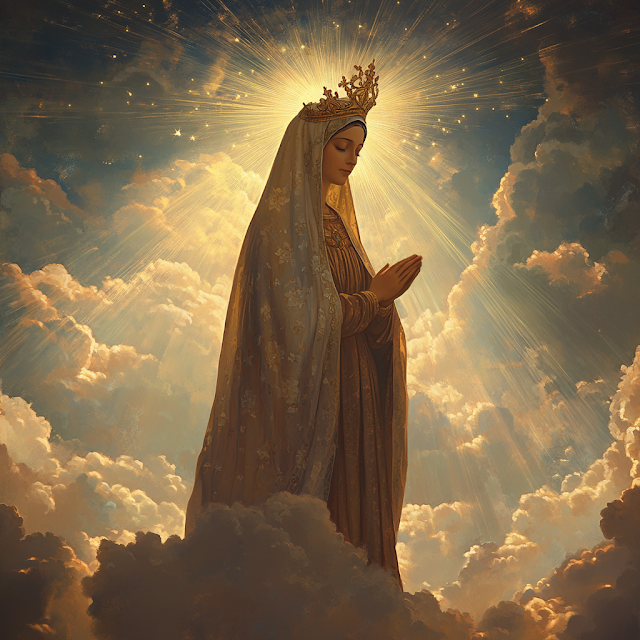
"Though my father and mother forsake me,
the Lord will receive me." Psalm 27:10

I also enjoy the company of many sainted friends that I have grown to love. The initial attraction sometimes has to do with the saint having been a hermit for at least part of their time on earth, and I look to them for guidance and example in how to lead that life. It warms me to understand how many of them there are! It's an extreme type of spiritual life, but yet there are many Catholics throughout history who have gone into the isolated, quiet places to pray in secret to the Lord in Heaven who rewards us in secret.

Later, some of these hermits attract other spiritual aspirants, and a community forms. Sometimes, the religious authorities, recognizing their holiness, would make them a bishop or the abbess of their own convent, and these people move from the hermit state to the cenobitic life. But there is something about spending some time in the hermit life that is an incredible help to the establishment of the spiritual aspirant in their relationship with the Divine.

As a side note to readers: even if you can only spend a dedicated weekend, or a week or two in a solitary setting, especially at a retreat center, monastery or convent, it will feed your spiritual appetites in a way that will stay with you forever. I promise. These experiences build upon one another. You will look back upon them with gratitude. And this is the perfect atmosphere in which to begin your contemplative journey with the saints.


Saint Lucy is one of my sainted friends in heaven upon whom I lay the task of interceding for me with the Lord so that I do not lose any more of my vision than I already have. I am functionally blind in my left eye and struggling to retain the vision in my right eye. At the present time, I have to get monthly injections into my right eye. After the 3-month period of getting these shots, the retina specialists will take photographs of the inside of my eye to determine if the shots have been able to stop the leakage of blood into my eyes by the invading blood vessels due to macular degeneration.

In celebration of the feast day of Saint Lucy, the patron saint of blindness, I am hereby giving an accounting of my personal experiences of the contemplative life, in connection with the establishment and maintenance of relationships with my favorite saints, of whom Lucy is one!

In the many years in which I have been disabled, I have accumulated a host of saints around me. This isn't a turn of phrase or mystical fancy. When you call upon anyone in the vast Heavenly Court, they respond to you in direct proportion to how much and how often you call upon them, in conjunction with the general state of grace in which you live.

Keep in mind that the deeper types of contemplative prayer will not typically include words or visuals. The consolations and atmosphere are different, but communing with the saints is a lovely phase that sets the stage for the mind before it enters into communion with the Holy Spirit.


Saint Lucy's feast day presents a very good opportunity for me to talk a bit about how I have made friends with the saints in Heaven.

In order to start the process of getting to know a saint, especially an obscure one, the first thing I typically do is some preliminary reading about the saint and get to know her a bit. The internet is a wonderful resource. A simple Google search for articles about the saint, as well as a trip through YouTube to check for educational videos, are both good resources. (Just check to make sure that the provider of the information is legitimately Catholic and not some cosmic poo-poo person who is selling crystal healings, "reiki sessions" or something like that!)


I usually find a prayer or two about that saint that has an official imprimatur, then I will light some candles and incense at my shrine, dim the other lights in the house, turn off the phone, use the sacramentals I have on hand, such as holy water, and begin.


Recently, I have started using some of Father Chad Ripperger's prayers from  his book of "Deliverance Prayers for the Laity." First, I will pray a version of his Invocation to the Entire Heavenly Court in order to sweep the decks of any lingering malevolent spirits, calling upon the entire heavenly court.

If you do not have the time to recite this entire prayer, then I recommend you pray any St. Michael prayer that you typically pray, something which is very easy to find on the internet and in many standard prayer books that you may have around the house.

Also, the short prayer to your Guardian Angel can be used at this juncture, instead of or in addition to the Invocation to the Entire Heavenly Court.


Invocation to the Entire Heavenly Court

O glorious queen of Heaven and earth, 
Virgin most powerful, thou who has the
power to crush the head of the ancient
serpent with thy heel, come and exercise
this power flowing from the grace of 
thine Immaculate Conception. 

Shield us under the mantle of thy purity
and love, draw us into the sweet abode
of thy heart, and annihilate and render
impotent the forces bent on destroying
us. Come most Sovereign Mistress of the
Holy Angels and Mistress of the Most
Holy Rosary, thou who from the very
beginning hast received from God the
power and the mission to crush the head
of Satan.

I humbly beseech thee, send forth thy
holy legions, that under thy command and
by thy power they may pursue the evil
spirits, encounter them on every side,
resist their bold attacks, and drive them
far from us, harming no one on the way, 
binding them immobile to the foot of the
cross, to be judged and sentenced by 
Jesus Christ, thy son, to be disposed of
by Him as He wills.

St. Joseph, patron of the Universal Church,
come to our aid in this great battle against
the forces of darkness, repel the attacks of
the Devil, and free me from whatever 
stronghold the enemy has upon my soul.

St. Michael, summon the entire Heavenly
court to engage their forces in this fierce
battle against the powers of Hell. Come, O
prince of Heaven, with thy mighty sword,
and thrust into Hell Satan and all the other 
evil spirits.

O Guardian Angels, guide and protect me/us.

Amen

You might also like to take advantage of one of the perimeter prayers which is very good protection when preparing your shrine for each period of meditation upon the saint, in which case I would recommend using the perimeter prayer as you are preparing the shrine, then begin with the Invocation to the Entire Heavenly Court.


Small book of St. Padre Pio's
prayers that I use almost daily


After the Invocation, I would then pray one of Saint Padre Pio's prayers to all the saints, as follows:

A Daily Prayer to the Saints

Dear beloved saint(s) ____(name)____
You are my friend(s) in Heaven.
You guide me, you help me, you are
there for me in my earthly journey.

As I live my life today, help me in my
daily activities and direct me spiritually,
so I can know and understand God's
plan for me.

Give me the grace and strength to assist
those in need. Help me to care for those
who need care.

Seek the Lord's blessings for me, so that
I may experience God's love and goodness
as you did, despite all the challenges and
obstacles in daily life.

Ask God to grant me the courage and
determination to always do what is right
for me, my family, and those closest to
me. Please hear my petitions and inter-
cede for my special intentions before our
Loving Lord.

_________(state your request_______
Amen.

This prayers is one for which I have made room in my daily schedule of prayers, in order that I may always keep in  mind my heavenly friends.

When making a special appeal to a particular saint, as we are discussing here, it also has a place in that cycle of prayers. At this point, after clearing away all negative attentions, gaining the assistance of the entire Heavenly Court, and addressing all the saints with Padre Pio's beautiful prayer, I would then pray the prayer to the specific saint with whom I am developing a relationship at the moment.


In today's case, it is Saint Lucy, whose prayer is as follows:

PRAYER TO SAINT LUCY:

Saint Lucy, you did not hide your light
under a basket, but let it shine for the whole 
world, for all the centuries to see. We may 
not suffer torture in our lives the way you 
did, but we are still called to let the light of 
our Christianity illumine our daily lives.

Please help us to have the courage to bring 
our Christianity into our work, our recreation, 
our relationships, our conversation - every 
corner of our day.

Amen


I then proceed with contemplation, by closing my eyes and meditating upon the day's saint. In the initial stages of appealing to any saint, there will be a very gradual movement toward one another. It can even take years before you are in regular communion with that saint, depending upon the state of your soul, how much time you put into this, and whether you are in a state of grace.


You know, the saints are simply people who lived on earth at one time and whose lives of faith were so exemplary that it has been determined that they are definitely in Heaven.  When asking for the saint's help in the form of intercessory prayers on your behalf, you are seeking them out in Heaven, where the entire Heavenly Court is spending all its time singing the praises of the Lord.

(Side note: Whenever I think of Heaven, I can almost hear the Heavenly Court singing the Lord's praises in the sweetest of notes! Can you imagine? What a blissful idea!)

You need to get the saints attention so that she may dedicate some of her prayers to your welfare, when she is joining in the prayers of the Heavenly Court.


I find that, in addition to the beauty of the words that you employ in your prayers, it helps to visualize Heaven as well.


IMAGINE HEAVEN


Reaching for Heaven
by Zulmaury Saavedra
at Unsplash


You might imagine, as I do, that you are walking upon the dazzling pavement of a heavily trafficked street paved with golden shimmering bricks or a glittering plaza, in a very big celestial city, with a crowd of sparkling beings gently moving about or swaying in place, their forms gracefully moving - with all of them lifting their voices to sweet celestial music and using beautiful gestures meant to glorify the Lord and participate in His beauty while the splendor of the Lord shines in and through everything. All the Saints are gathered around  the Lord who is at the center of it all, flanked by his Blessed Mother and the angels, and it is gorgeous. Personally, I hear bells throughout, but that's just me.

Obviously, the English language, and our own imaginations, cannot come anywhere near the glory of what goes on in Heaven, but we have to work with images and situations that are familiar to us until the door is opened for us and we experience a more closely representational vision of the Heavenly abode.


I may imagine that I enter Heaven and begin to walk its Heavenly illuminated streets, and then I see a shining person on the other side of the street or the plaza, walking on that other side, perhaps traveling in the opposite direction from me and I just see the back of their head.

Everyone and everything is full of light, and all their spiritual forms expand in time to the music they offer the Lord. In one way or another, they are all communicating with the Lord. Angels are flying in the sky. Saints are walking the illuminated structures. Everything is radiating a dazzling light!

This is the imagery that appeals to me, but you will find your own way through that supernatural place.


In the beginning, you may only have a fuzzy impression of what the saint looks like. It helps to call upon the iconography. Saint Lucy, for instance, today's special saint, is often represented holding a small plate or bowl containing her eyes that were plucked out of her head during her lifetime. [It is a gruesome image, I know, but she lived during the time of Diocletian, whom you may have heard of. He was a brutal man who was responsible for the torture and terrible deaths of many Christians of his era. He was emperor from 284 to 305 C.E.] One of the stories claims that Lucy plucked out her own eyes because a suitor became enamored of their beauty. Another tale claims that it was done to her in the middle of some torturous act.]


In order for you to get the attention of any particular holy person, you have to call upon her intently so that the saint, angel or even our Blessed Mother will hear you. This is how it is in the beginning of this spiritual practice when one has yet to make an intimate friendship with the saints by consistent, regular attention to them.

After the initial prayers, and you feel you have made contact with the saint, you will want to spend some time just communing with her in that holy place.

THE RELATIONSHIP GROWS

After the first introductions, the saints will start to listen for your call, knowing it will come. Then they will themselves draw closer, until finally they are living in your heart and you are in communion with them all the time. Once you have established a practice of communicating with them, your attachment to them, and they to you, can be instantaneous, in my experience.


Eventually, I have been on such intimate terms with the saints that I feel their presence within me throughout the day and can conjure up a conversation or companionship in a moment. 

This is especially true for the saints who are my actual ancestors, who I believe have been praying for me my entire life. I believe that they watched the birth and growth of all their various grandchildren, praying for them through the trials and tribulations of their lives, interceding for them with the Lord.

Saint Eahlswitha,
Wife of Saint King Alfred the Great
My 33rd Great Grandparents


Sometimes, in the quiet of a late evening, you will want to go to them in Heaven. At other times, during the day, when faced with the problems of life, you may need them right here in the earthly plane, in order to inspire and encourage you in whatever you face in your worldly life.

I will OFTEN ask myself, "what would this saint do if they were faced with a similar circumstance?" I find it very helpful to posit this question because I will often receive an answer fairly quickly.

GUARDIAN ANGELS


This process works well for your Guardian Angel also because this special angel, who has been tasked with caring for you since your birth, will actually feel thrilled that you are giving them some attention. Every time you call upon your Guardian Angel, you are allowing it to fulfill its entire purpose. Created solely to keep its eyes on you and help you, it can grow to feel cold and lonely despairing of ever truly pleasing God, if you don't give it any opportunity to help you.

Like all angels, each Guardian Angel is its own species of spiritual being. There is no other spiritual being made exactly like any one of these angels who is yours and yours alone. I have read some accounts in which it is claimed that your Guardian Angel looks exactly like the person for whom they were created.

So, if you are meditating on finding a saint in Heaven in order to obtain her intercession for your needs, and you come across an angel that looks exactly like you, don't be surprised.


Painting of cherubs by 
William-Adolphe Bouguereau


I would just say that it is probably a good idea to make sure that you first have a good relationship with your Guardian Angels before you start running around the spiritual realm, giving all sorts of attention to one saint or another, while ignoring your poor Guardian Angel and making it sad.

In fact, it will be much easier getting it to help you than some old saint, since you are your Guardian Angel's only job and responding to you is part of its duty.

I say "it" when I refer to angels because, in fact, they have no gender. While they sometimes come to earth and appear to us in some form that does, at times, appear to be human of a specific gender,  they have never been earthly beings. There is no marriage among angels and no angel babies being birthed. God creates angels out of His very holy will, so there is no necessity for them to be either male or female. On the other hand, God can do whatever he wishes, and if it really IS true that at least some of the Guardian Angels look like their charges, then it is possible that they appear to be either male or female without actually having a specific gender, per se. It's one of those mysteries.


While your Guardian Angel is a celestial being, the saints were and continue to be real people who have moved from the worldly to the heavenly realm.

DON'T ASK YOUR DEAD GRANNY TO PRAY FOR YOU.

Many people like to believe that everyone who has died is certainly in Heaven, but in the Catholic faith this is not strictly true. If a person does not die in a state of grace and has a lot of sins to clear up, they cannot enter Heaven. I believe this is why Jesus told us to "be ye perfect as thy Father in Heaven is perfect."

Many of our relatives will be in purgatory for some time, in order to clean up whatever sins were on their soul when they died. They need our attention also, and the best thing we can do for them is to pray for them to the Lord, make reparations for the sins left on their souls, and otherwise offer sacrifices for them, such as dedicating a period of fasting to them. Appealing to the saints and to the Guardian Angels of our loved ones who have died is also a very good idea. Their intercessory prayers can be helpful to your deceased relative.

It occurs to me that, at least for the devout among us, the pain of finding oneself in purgatory instead of Heaven might be so horrifying and painful that this moment alone might be enough to burn up our sins in an instant, sending us to Heaven quickly thereafter. I, for one, imagine I would go flying into Heaven singing prayers of gratitude for having escaped Hell and being let into Heaven at all.

When I see the Guardian Angels of the souls in purgatory, I imagine them downcast and sad, no longer able to help their charges except by praying to The Lord that they be released from purgatory.


The saints are deceased humans whom The Church has assured us are living in Heaven because of the unique spiritual character of their lives on earth. We can feel confident that these souls are able to intercede for us because we know they are in Heaven, while those in purgatory can not.

Purgatory is not Hell. It is a stopping place. It is not a gruesome and permanent place of torment, like Hell, but neither is it Heaven. The souls in purgatory cannot help us. They cannot even help themselves, except through the suffering of purgatory which purifies their souls. I have a strong suspicion that simply being unable to enter Heaven would be an awful suffering. I think I would yearn for Heaven so strongly that not being able to go there immediately would itself be an immense pain. 

When the soul has been purified sufficiently through suffering, the prayers of the faithful on earth, the intercession of the saints, and the grace of God, they are allowed to enter Heaven. It is pointless to ask your deceased Granny to help you out of a jam. We don't know, for certain, if Granny is in Heaven or not. She MAY be. We just don't know. But we DO know that the Saints are in Heaven, so it is best to save our appeals for those we know are in Heaven: the saints, the angels, our Blessed Mother, Jesus, and God the Father.

One thing we should remember is that the saints are humans. Our relationships with them are real relationships with real people who are living in Heaven. They have not been transformed into magical beings, nor are they angels, which many people incorrectly assume they have become. Angels are a different species. In fact, each angel is completely unique and is its OWN species entirely different from all others, but that is a different story entirely.

When building a relationship with the saints you are building a real relationship with a real person. It does not happen by magic, nor is it typically an instantaneous, effortless thing. If it does appear to be magical and instantaneous, you either have a remarkable imagination, or there is a demon chasing you and trying to trick you by appealing to your ego. 


I would take care to be sure and pray all the deliverance prayers at your disposal and clear the perimeter of your prayer space. Call in Saint Michael and your Guardian Angel to watch over you while you pray, and you should be alright. It's also a good idea to play Gregorian Chant in your home regularly.

If your experience is anything like mine, the more saints and angels you get to know in this way, the more you will be aware of the presence of a growing family of saints and angels who are with you all the time. In this way, the kingdom of Heaven is within you. The holy ones are with you. This is what I experience and what I hope for you as well.


DON'T MAKE IT MORE DIFFICULT THAN IT HAS TO BE!

In order for this to happen, I believe you should be in a state of grace in your life, committed to living as sinless a life as what is possible for you. God is all good. Heaven is a place of purity, peace and perfection. Evil and sin are incompatible with deliberate sin. Accessing the Heavenly realm does not seem possible if one is in a sinful state.

So, if you are deliberately sinning and assuming that God will be alright with it, becoming familiar with the saints will be more difficult. Confession and reception of the Blessed Sacrament, use of all the sacramentals such as holy water and blessed salt, helps provide a fertile ground for the growth of divine relationship between you and the Holy Ones. That is my belief and experience.

Those of us under either private or formal vows will typically promise "poverty, chastity and obedience." Americans often have trouble following ANY of these vows, and that is exactly what makes our spiritual lives more difficult than they have to be.

With regard to poverty, many of us have no problem with that. We have no extra money and, in fact, do not have enough for what we consider to be our needs. If we DO find ourselves with excess belongings that do not have a place in our working lives or our state of life, there is usually no problem getting rid of these. Giving to the poor is something I have found very easy to do. We are surrounded with poor people, even those who are so poor they do not have even a home to live in! It's shameful, really, but that is a topic for another blog.

Chastity is the virtue that most Americans ignore completely. Because of this phase of modernism, American Catholics have changed the rules for themselves. I can tell you confidently, however, that anyone having sex outside a valid marriage is going to have problems with their prayer life. Tell yourself whatever you like. God did not change the rules. People did. And when people change God's rules, trouble ensues. It is just a fact.

Even the Hindus with whom I studied before getting baptized had very strong teachings about the necessity for the control of the sexual expression. Their reasoning is different, but the result is the same.

If you want to make progress in your spiritual life, get your physical life in order in this area, and I guarantee you that you will experience tremendous relief. The flood gates will open and the difficulties will lessen.

Likewise with regard to obedience. For lay people, obedience means first of all obedience to the rules of the Catholic faith. Get familiar with the Catechism. It's a huge book, I know, but the YouTube classes "Catechism in a Year" is a great place to start. There are also classes you can take at your parish.

Once again, the more in line is your behavior with the principles of The Faith, in all areas, the easier and more satisfying your prayer life is going to be.

ATMOSPHERE HELPS

In fact, whatever we can do to inspire ourselves in our surroundings, such as tending to an appealing and beautiful domestic Shrine and altar in our homes, can also be quite helpful to get us centered and concentrated on our spiritual practices, such as this one. 


Father Chad Ripperger, well known Catholic exorcist, tells us that Gregorian Chant chases away Satan and his demons. It hurts their ears to hear these holy sounds! In gathering the holy saints to yourself, you do not want to gain the attention of the fallen saints, so keep that in mind as well.

One day I will make a blog post about home shrines and the various items that can help you maintain your spiritual atmosphere and attitude.

Finally, I will add that getting to know the saints and developing relationships with them has been particularly beneficial for all phases of my life and my spiritual practices, especially since I discovered I am descended from some of these people. This is particularly helpful for me, since I do not have any living close family. The saints in Heaven, the angels, and our Blessed Mother and our Loving Lord have literally become my day-to-day family and they can become part of your intimate family also!

I hope this post is helpful to all of you. If you have any questions, feel free to write a comment or contact me on Facebook.

In the meantime -

God bless us all!

Silver Rose